Backgrounder
What You Need to Know About Pennsylvania’s 2026-27 State Budget Deal
Summary
Pennsylvania’s 2026–27 state budget deal is an improvement over Gov. Josh Shapiro’s reckless proposal, but it still spends too much and leaves taxpayers facing an even larger long-term structural deficit.
The general fund budget spends nearly $52.2 billion—counting $1.3 billion in Medicaid costs shifted to next year. That would be more than $1 billion less than Shapiro’s original $53.3 billion proposal, but still far above a fiscally responsible spending path.
Shapiro’s proposal would have increased spending by billions, raised taxes, relied on $4.6 billion from the Rainy Day Fund, and worsened Pennsylvania’s already-serious structural deficit.
The good news: the deal avoids several of Shapiro’s and House Democrats’ worst ideas. It does not raid the Rainy Day Fund, nor include broad-based tax increases, rejects Shapiro’s cruel and chaotic cuts to tax credit scholarships for low-income students, does not include combined reporting, a mass transit bailout or a minimum wage increase, and maintains the scheduled reduction in the Corporate Net Income Tax.
The bad news: the budget still spends too much, includes a large increase in public school spending with no accountability, does not expand school choice, and fails to address the state’s long-term spending problem or make Pennsylvania more competitive.
Key Takeaways
- Spending remains too high. The $52.2 billion budget represents excessive spending growth and an unsustainable structural deficit.
- The 4.1 percent spending increase exceeds the Taxpayer Protection Act index of 3.1 percent and means Pennsylvania is spending $4.6 billion more than recurring revenues.
- No Rainy Day Fund raid. Unlike Shapiro’s proposal, the deal avoids taking money from Pennsylvania’s emergency savings account. That is a significant taxpayer protection.
- No help for kids waiting for educational choice. The budget doesn’t include any increase for Pennsylvania’s tax credit scholarship—where nearly 70,000 scholarship applications were turned away in 2023-24 (latest available data)—or to address waiting lists for charter schools while school districts continue to block charter options. Nor does the deal include opting Pennsylvania into the federal scholarship tax credit, missing a major opportunity to help families with no cost to taxpayers.
- Uses “couch cushion” money. The framework relies on money from the “shadow budget” and lapsed funds—money taxpayers have already paid, but state bureaucracies have been sitting on for years. This approach protects taxpayers and is preferable to raising taxes or draining the Rainy Day Fund.
- Commonwealth Foundation had identified roughly $5.3 billion in excess balances in special funds and more than $2 billion in prior-year lapses that lawmakers must examine before considering tax hikes or reserve fund raids.
- Lawmakers clawed back $1.2 billion in prior lapses as part of the deal and transferred another $580 million from the shadow budget in 2026-27.
- No new taxes. The deal rejects Shapiro’s push for new revenues, including higher taxes on skill games, marijuana, and other new sources.
- CNIT reductions remain on schedule. Maintaining Pennsylvania’s scheduled Corporate Net Income Tax reduction is essential for competitiveness and economic growth.
- No cuts to education scholarships. The deal rejects the cruel and chaotic approach pushed by Shapiro and House Democrats to cut resources for scholarship organizations and threaten educational opportunities for thousands of students.
- No charter school cuts. Likewise, Shapiro had proposed further cuts for public cyber charter schools, and House Democrats advanced legislation to cut funding for brick-and-mortar public charter schools—even though charter schools already get significantly less funding per student.
The Budget Avoids the Worst-Case Scenario
The deal represents an improvement from Shapiro’s, irresponsible, unaffordable, and unrealistic budget proposal.
Shapiro proposed a $53.3 billion spending plan and sought to balance it by illegally draining $4.6 billion from the Rainy Day Fund. That would have drained emergency reserves at the very moment Pennsylvania faces rising Medicaid costs, continued spending pressure, and a multibillion-dollar structural deficit.
The budget deal avoids that mistake. The $52.2 billion budget deal reduces Shapiro’s request by $1.2 billion—and over the course of the past four years, the legislature has cut Shapiro’s proposed spending by a combined $3.6 billion.
Preserving the Rainy Day Fund is critical. Pennsylvania’s emergency reserves are meant for recessions and true fiscal emergencies, not to paper over unsustainable spending growth.
The agreement also avoids several major policy mistakes: no broad-based tax increases, no minimum wage hike, no mass transit bailout, and no delay in the scheduled CNIT reduction. These are important wins for taxpayers and employers.
As expected, none of Shapiro’s proposed new taxes—on legalized recreational marijuana, on skill games, or by squeezing more from corporate taxes via onerous regulations—have moved forward.
Likewise, lawmakers wisely dismissed Shapiro’s costly green energy scheme in this deal; the Lightning Plan would have further driven up energy costs and destabilized the electric grid with a new energy tax and additional mandates.
The Structural Deficit Remains the Central Problem
Even with these improvements, the budget’s biggest flaw is that it spends too much.
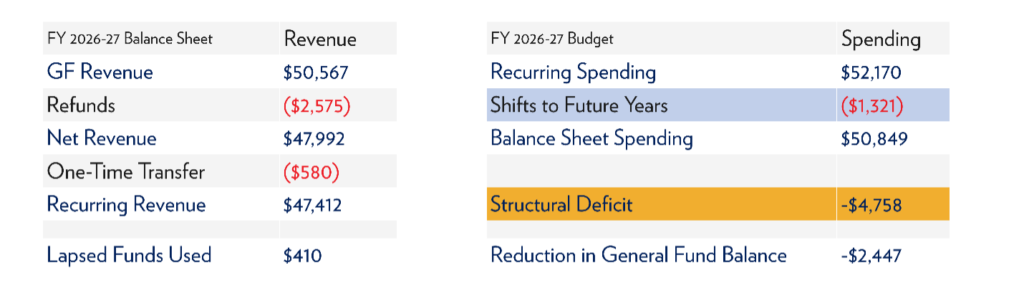
While the official balance sheet shows a $50.849 billion budget, the true spending number to compare is $52.170 billion—as $1.3 billion in Medicaid costs were deferred, simply moving those costs to the next fiscal year.
The $52.2 billion in ongoing costs represents $4.9 billion more than recurring revenue, increasing the structural deficit.
Pennsylvania’s Independent Fiscal Office has projected a long-term structural imbalance, with expenses expected to outpace revenues over the next several years.
The budget deal also includes a COLA for retired government employees that is estimated to cost taxpayers $168 million each year for the next ten years.
While the deal protects the Rainy Day Fund and prevents tax hikes for another year, unless lawmakers control spending growth, reform major cost drivers, and impose real fiscal discipline, Pennsylvania will face the same budget fight again next year.
Lawmakers Are Tapping Pennsylvania’s “Couch Cushions”
Rather than raising taxes or draining emergency reserves, the deal uses money from the “shadow budget” and lapsed funds.
That is the right place to look first. Pennsylvania has more than one hundred special funds, often referred to as the “shadow budget.” Commonwealth Foundation identified 34 special revenue funds with approximately $5.3 billion in cash balances, many with balances exceeding a full year of operating expenses.
The commonwealth also had more than $2 billion in lapsed funds—appropriations that were made in prior years that were never spent; that state bureaucrats were sitting on rather than returning to the treasury.
The budget deal uses $580 million from shadow budget reserves and reclaims $1.24 billion in lapsed funds to pay for the spending without tax hikes or tapping emergency reserves.
Using these funds is not a substitute for spending restraint, but it is far better than taking money from the Rainy Day Fund or imposing new taxes on Pennsylvania families and employers.
Education Spending Goes Up Without Accountability
One major concern is the $896 million increase in state support for public education, including $530 million in adequacy funding with no strings attached.
This adds to a total of $18.6 billion for state support of public schools, an increase of $5.4 billion (41%) in just the last five years. That is a significant increase in public school spending without meaningful reforms, accountability, or student-centered conditions—even as enrollment is falling.
Pennsylvania already spends $24,000 per student, yet too many students remain trapped in underperforming schools.
A better budget would pair any public school funding increase with serious accountability and an expansion of school choice.
School Choice Families Get Left Behind
Unfortunately, the budget deal does not meaningfully expand educational choice.
That is a missed opportunity. Pennsylvania’s Educational Improvement Tax Credit and Opportunity Scholarship Tax Credit programs help tens of thousands of students attend schools that better meet their needs. Even more, these programs save taxpayer dollars.
These programs serve students at a fraction of what taxpayers spend in the district school system and remain among the most effective education reforms in Pennsylvania.
At least, lawmakers were wise to reject the cruel and chaotic cuts to educational choice advanced by Shapiro and House Democrats, including proposals that would cut or restrict scholarship organizations and destabilize scholarships for low-income families.
Shapiro and House Democrats pushed legislation that would have cut funding for K-12 scholarships, threatened scholarship organizations, undermined donors, and injected uncertainty into a successful program that families rely on. They also wanted deep cuts in funding for charter schools—both cyber schools and brick-and-mortar charter schools.
Thankfully, parents and schools got wind of these plans and pushed back, protecting educational choice for thousands of students.
Worst Impacts for Taxpayers Avoided… for Now
The emerging agreement includes several important taxpayer protections.
- First, it includes no new taxes. That is especially important given Shapiro’s push for new revenue sources in his budget proposal. Pennsylvania does not have a revenue problem; it has a spending problem. Gov. Shapiro’s plan would have cost the average family of four $2,100 per year.
- It maintains the scheduled CNIT reduction. Pennsylvania has made real progress by reducing its Corporate Net Income Tax rate, which had long been one of the highest in the country. Staying on schedule sends the right message to employers and investors.
- It avoids a mass transit bailout. Transit agencies should pursue internal reforms, fare and service changes, and efficiencies before demanding more money from statewide taxpayers.
- It avoids a minimum wage increase. Wage mandates would raise costs for employers and reduce opportunities for entry-level workers.
- It rejects Shapiro’s energy taxes and new mandates—part of the Lightning Plan—which would drive up electricity rates for families.
The Bottom Line
The emerging state budget deal is significantly better than Shapiro’s original proposal, but it is not a fiscally responsible budget.
Lawmakers deserve credit for protecting the Rainy Day Fund raid, rejecting new taxes or costly energy mandates, tapping the couch cushions of the “shadow budget,” preserving the CNIT reduction, and rejecting cuts to scholarship organizations or charter schools.
But the budget still spends too much, adds hundreds of millions in public school funding without meaningful accountability, and leaves Pennsylvania with a huge structural deficit. It does nothing to expand educational choice or provide additional support to low-income students trapped in failing schools.
A responsible budget would control spending, use shadow budget surpluses and lapsed funds before touching taxpayers or emergency reserves, protect the scheduled CNIT reduction, reject corporate welfare, reform Medicaid, and expand education opportunity for families.
While this deal avoids the worst-case scenario, it should not be mistaken for fiscal discipline.