Stay Informed
"*" indicates required fields
Blog
More Money for Public Schools Isn’t Working
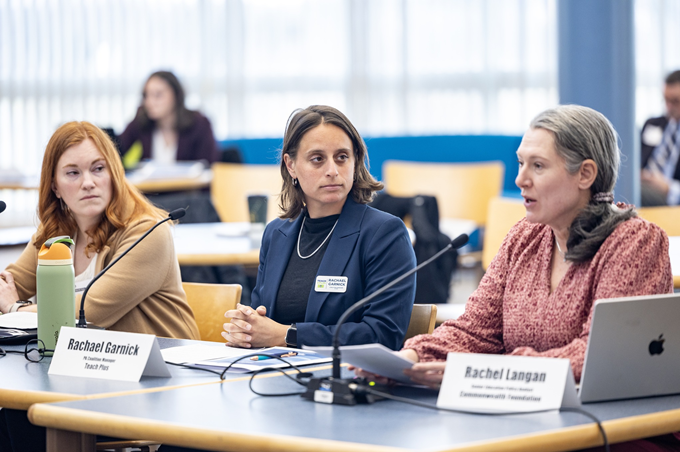
On January 12, Rachel Langan, senior education policy analyst for the Commonwealth Foundation, testified before the Pennsylvania Senate Majority Policy Committee. Rachel provided insight and commentary about the importance of school choice to improving academic achievement in the Keystone State.
What follows is her testimony. Video of her presentation is also available here (starting at 1:23:40).
Testimony of Rachel Langan
Senior Education Policy Analyst
The Commonwealth Foundation for Public Policy Alternatives
Hearing on Improving Reading Outcomes in Pennsylvania
Before the Pennsylvania Senate Majority Policy Committee
The Honorable David Argall, Chair
January 12, 2026
Good afternoon, Chairman Argall, Senator Pennycuick, and members of the Senate Majority Policy Committee. My name is Rachel Langan, and I am the Senior Education Policy Analyst at the Commonwealth Foundation. I am also a former public school librarian and mom to five kids, the oldest of whom has dyslexia.
Thank you for inviting me to speak on this important topic.
The Commonwealth Foundation advances student-centered policy solutions that empower families and improve outcomes for all Pennsylvania students.
At the Commonwealth Foundation, we believe that Pennsylvania’s educational policies should prioritize fairness, transparency, accountability, and the opportunity for every child to access a high-quality education, regardless of their zip code.
Thank you for the invitation to testify, and my thanks to the rest of the committee for your attention to this critical and urgent issue.
Key Points
My remarks today are focused on three realities:
- Student test scores are declining while state spending on public education is increasing.
- Increased funding is not leading to improved outcomes.
- Pennsylvania needs more high-quality education options for all students.
Test Scores are Declining
According to the Annie E. Casey Foundation, students who can’t read at grade level by the end of 3rd grade are four times more likely to drop out or fail to graduate from high school. For Black and Hispanic students, that likelihood doubles.
According to the National Center for Education Statistics (NCES), 23 percent of 16- to 24-year-olds in Berks County are reading at the lowest literacy levels, indicating that one in five recent high school graduates in this community is functionally illiterate.
Data for neighboring Montgomery County is even worse, where 40 percent of young people is functionally illiterate. Many of them struggle in ways that are almost impossible for a fluent reader to imagine. They can’t order from menus, access healthcare, or fill out a job application. Poor literacy skills perpetuate poverty, increase the likelihood of incarceration, and cost the U.S. over 1 trillion per year in social services, health care, and lost wages.
Data from the Pennsylvania Department of Education shows that less than half of students in grades three through eight statewide can read, write, or perform basic math at grade level.
Only 48.5 percent of elementary students are proficient in reading and writing, and even fewer, 41.7 percent, are proficient in math.
Public School Spending
The 2025-26 Pennsylvania state budget will spend $17.7 billion on public education, an increase of $7.2 billion since 2015-16. Including local and federal revenue, Pennsylvania spends more than $23,061 per student per year on K-12 education.
Increased spending is NOT leading to improved outcomes.
Public education spending in Pennsylvania has increased by 68 percent over the last decade, yet fewer students are reading on grade level than they were a decade ago.
In 2015, 6 out of 10 of Pennsylvania’s elementary students were proficient in reading and writing, compared with just 4 out of 10 today.
Families Need More Options
Students attending low-performing schools don’t currently have many options. They can:
- Continue to attend a low-performing school;
- Apply to a public charter school, where there are more applications than seats available, as evidenced by the Philadelphia School’s charter waitlist of 16,000 students;
- Attend a public cyber charter school; or
- Transfer to a private school if their family can afford tuition.
Pennsylvania tax dollars should follow all students, regardless of zip code, to the school of their choice, whether public, private, charter, career and technical, or home education programs.
A step towards addressing the inequity in Pennsylvania’s education system would be to fund students directly.
Not only would this empower families to choose the best school for their child, but it would also be a step towards fulfilling Pennsylvania’s 2023 Commonwealth Court ruling, which states that lawmakers should work to ensure “every student receives a meaningful opportunity to succeed.”
Solutions
Curriculum reforms and efforts to improve literacy are necessary and commendable, but they are not enough to produce steady improvement in academic achievement.
However, there are three ways to expand educational options in Pennsylvania that would provide immediate relief to students attending low-achieving schools.
1. Fund students directly.
When education spending follows students to their chosen school, parents are empowered to find the school that is best for their child.
2. Expand tax credit scholarships for K–12 students.
Pennsylvania has two tax-credit scholarship programs: the Educational Improvement Tax Credit (EITC) and the Opportunity Scholarship Tax Credit (OSTC). Together, these programs provided tuition scholarships for 101,000 low-income students in the 2023–24 school year (the most recent data available). However, the programs also denied nearly 69,000 students scholarships due to program caps. Increasing funding for Pennsylvania’s tax credit scholarships is vital to expanding the program and meeting the needs of low-income families in PA.
3. Pennsylvania must opt in to the Federal Tax Credit Scholarship.
Congress approved the federal tax credit scholarship in July 2025 and will expand scholarships to all 50 states by 2028. This program will benefit tens of thousands of kids in Pennsylvania by providing tuition assistance to kids attending private schools—and will even provide additional funding to public school students for activities, such as after-school programs, tutoring, and special education services. However, for Pennsylvania to benefit from this program, Governor Shapiro must opt in by December 31, 2026.
Conclusion
In conclusion, addressing educational inequity in Pennsylvania won’t be quick or easy and will require cooperation and creative problem-solving solutions.
- State lawmakers should work with the governor to ensure that Pennsylvania opts in to the federal tax credit scholarship program;
- Lawmakers should increase funding to EITC and OSTC programs; and
- Lawmakers should direct education funding to follow the child to the school that best fits their needs because every child in Pennsylvania deserves a high-quality education, regardless of their zip code.
Again, thank you. I would be happy to address any questions you may have.
Rachel Langan
Senior Education Policy Analyst
Commonwealth Foundation
Topics on this page
Connect With Us
Email Sign Up
"*" indicates required fields