Stay Informed
"*" indicates required fields
Blog

Pennsylvania Courts Never Ordered More Funding for Public Schools
One of the best-kept secrets in Pennsylvania is the outcome of the 2023 Commonwealth Court ruling on public education funding.
Myths and disinformation abound. But few are as pernicious as the misguided claim that Pennsylvania is under a court-ordered obligation to increase this funding at the state level.
The facts tell a different story.
In 2014, several parents, advocacy groups, and low-income school districts sued the Pennsylvania Department of Education. The lawsuit claimed that Pennsylvania’s heavy reliance on local property taxes for school funding created disparity between poor and wealthy school districts, violating the state’s constitutional requirement for a “thorough and efficient” system of public education.
From the beginning, the plaintiffs made it clear that, in their opinion, the best remedy to the disparity was more state funding—an additional $4.6 billion in tax dollars, to be exact.
Nearly ten years later, the 2023 Commonwealth Court rejected the request for $4.6 billion and did not order any specific measures or solutions to make education funding more equitable. In fact, on page 438, section 1906 of the ruling, the judge, Renée Cohn Jubelirer, refers to the Costing Out Study, a study that presumed that more spending equals better results, without accounting for how education dollars are spent or whether they improve academic outcomes. Jubelirer noted:
“[T]he Court is not convinced that the adequacy shortfalls derived from the Costing Out Study definitively measure the amount of revenue districts throughout the Commonwealth will need in the future to provide each student a thorough and efficient education.”
This indicates that the court did not identify the amount of revenue needed to address inadequacies in the funding formula.
Instead, Jubelirer ruled (see page 776) that,
“The only requirement, that imposed by the [Pennsylvania] Constitution, is that every student receives a meaningful opportunity to succeed academically, socially, and civically, which requires that all students have access to a comprehensive, effective, and contemporary system of public education.”
Furthermore, the judge noted:
“[The order] does [not] require reform to be entirely financial. … The options for reform are virtually limitless.”
The use of “virtually limitless” indicates that increased funding is one way to address inadequacy, but the commonwealth could and should consider other methods, too.
Jubelirer’s ruling concludes, “It is now the obligation of the Legislature, Executive Branch, and educators, to make the constitutional promise a reality in this Commonwealth.”
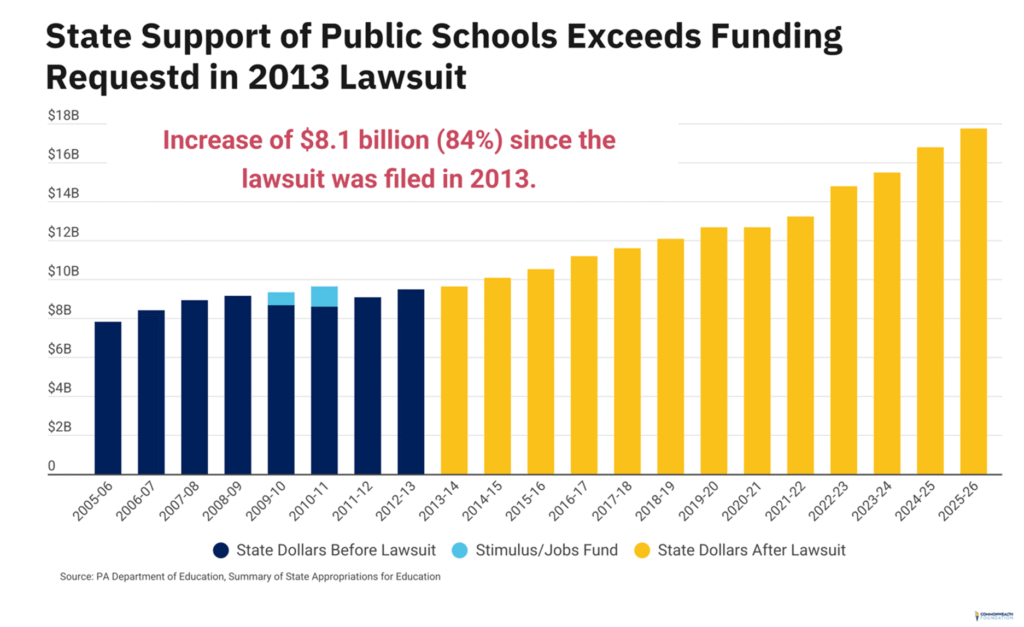
Since the initial legal filing in 2013, the Pennsylvania legislature has increased state funding for public schools by more than $8 billion, nearly twice the amount sought by plaintiffs.
In addition, 11 districts received an additional earmark, totaling $14 million in Pennsylvania’s 2024–25 budget. One of those districts, the William Penn School District (a plaintiff in the 2013 filing), received an additional $1 million in 2024–25 and $5 million in the 2025–26 budget, in addition to guaranteed annual increases. As a result, the district’s overall budget increased by 22.3 percent in one year.
However, more money does not solve the problems plaguing Pennsylvania schools. The William Penn School District has scored among Pennsylvania’s lowest-achieving schools every year since at least 2018.
If more money isn’t the answer, what is?
In 2023, the Pennsylvania General Assembly introduced and voted on legislation that would address inadequacies, such as Lifeline Scholarships and the Learning Investment Tax Credit.
By all appearances, Lifeline Scholarships would provide immediate relief to low-income kids attending Pennsylvania’s worst-performing public schools by offering them tuition assistance to attend higher-performing private schools.
However, Gov. Josh Shapiro vetoed Lifeline Scholarships, the single piece of legislation that would have simultaneously addressed economic and academic inequities for more than 200,000 Pennsylvania kids.
Furthermore, Governor Shapiro openly advocates for inequality and segregation by cutting funding to cyber charter school students. Cyber charters house students who are more likely to have special education needs and more likely to be homeless than brick-and-mortar public school students.
This misunderstood ruling made clear that Pennsylvania is under no judicial mandate to pour more money into public education.
Yet, misinformation continues to distort that truth. Lawmakers have substantially increased education funding, far beyond what plaintiffs initially sought. However, academic and structural challenges persist, underscoring the court’s finding that solutions must extend beyond financial inputs alone.
If Pennsylvania is to fulfill its constitutional responsibility and provide every student with a meaningful opportunity to succeed, policymakers must embrace innovative, student-centered reforms and educational choice rather than doubling down on the ineffective methods that brought us to this point in the first place.
Connect With Us
Email Sign Up
"*" indicates required fields