Deficit Watch

Deficit Watch: May 2026
Background
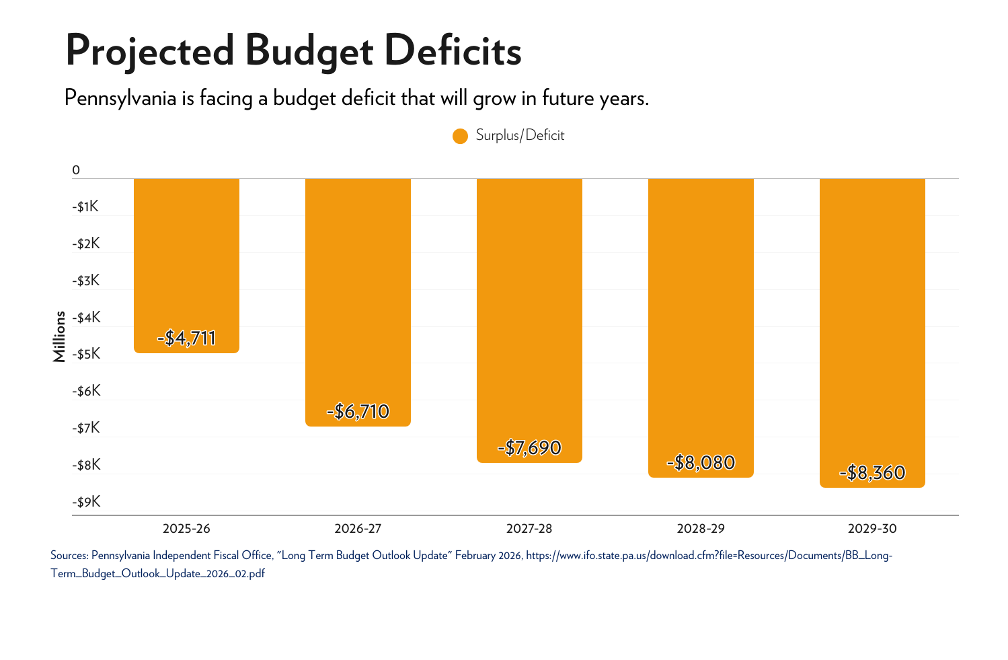
- Pennsylvania continues to face serious fiscal challenges. The enacted 2025–26 General Fund budget created a $4.6 billion structural deficit. Gov. Josh Shapiro’s 2026–27 budget proposal would increase the deficit to $6.8 billion. Under the current policy and spending growth, long-term forecasts indicate daunting deficit increases in future years. If left unaddressed, the budget deficit will represent a tax increase of $2,100 per family of four beginning in 2027.
Revenue Estimates and Collections
- The $6.8 billion deficit equals the difference between net revenue (projected revenues minus refunds) and proposed spending (including one-time transfers). For the 2026–27 budget plan, these are $46.4 billion and $53.3 billion, respectively.
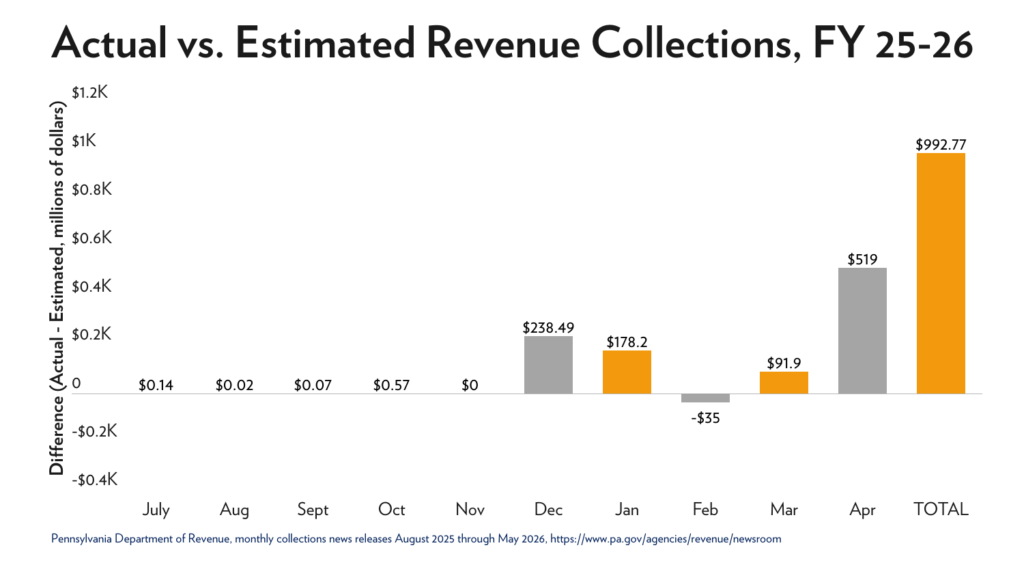
- In April 2026, Pennsylvania collected $6.72 billion in revenue, $519 million above the official revenue estimate. In total, fiscal year (FY) 2025–26 collections are $992.77 million above estimated revenues. Despite higher-than-expected FY-to-date revenues, a gap of more than $3.6 billion between revenues and approved spending remains.
- Shapiro’s 2026–27 budget proposal drastically overestimates the impact of his proposed tax increases. A February analysis by the Pennsylvania Independent Fiscal Office (IFO) calculates Shapiro’s revenue estimates for his marijuana, skill games, and combined reporting proposals exceed IFO estimates by $4.4 billion over the next three fiscal years.
Recommendations
- Lawmakers must act now to reduce the structural deficit to protect working families from tax increases. Legislative measures that would help cut deficit and wasteful spending include:
- Implementing welfare reforms that strengthen work requirements and eligibility verifications to reduce fraud.
- Insisting Shapiro opt in to the Federal Scholarship Tax Credit, alongside passing other education reforms to ensure education funding follows children, such as expanding state tax credit scholarships and Lifeline Scholarships.
- Supporting the Taxpayer Protection Act (TPA), a fiscal guardrail that limits state spending growth to the average rate of inflation plus population growth or personal income growth.
- Eliminate all corporate welfare and economic development spending to lower tax rates for every Pennsylvanian. This would reduce the personal income tax (PIT) rate to 2.82 percent, saving a family of four roughly $530 annually, and instantly lower the corporate net income tax (CNIT) to 5.75 percent.
- Pass the Regulations from the Executive in Need of Scrutiny (REINS) Act, requiring a formal cost verification process, followed by a mandatory vote in the General Assembly for regulations with an annual financial impact of $1 million or more.