Fact Sheet

Education Tax Credits Deliver Over 100,000 Scholarships, Yet Waitlists Remain
Summary
- For the first time since inception, Pennsylvania scholarship organizations awarded over 100,000 scholarships during the 2023–24 school year through the Educational Improvement Tax Credit (EITC) and Opportunity Scholarship Tax Credit (OSTC) programs.
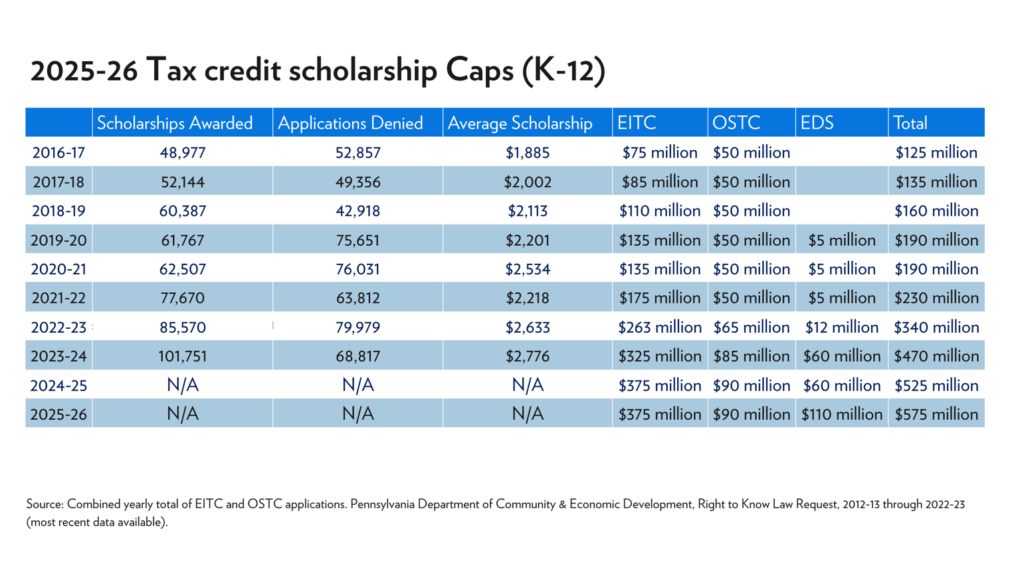
- Scholarships were awarded to 101,751 students in the amounts of $2,701 for EITC and $3,186 for OSTC students.
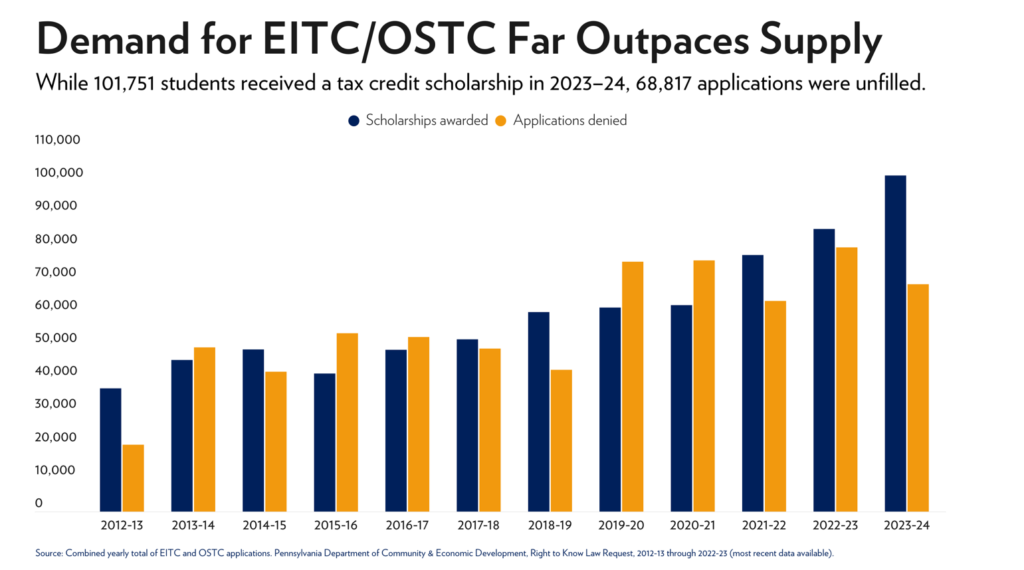
- In 2023–24, K–12 students in Pennsylvania submitted 169,776 scholarship applications, the highest on record. Unfortunately, 40 percent, or 68,817 student scholarship applications, went unfunded due to arbitrary program caps.
- To address the unmet need of tens of thousands of students with denied tax credit scholarship applications, state lawmakers must continue to expand EITC and OSTC; create new funding paths to access school choice options, such as Lifeline Scholarships and the Learning Investment Tax Credit (LITC); and must pass legislation to ensure that Pennsylvania opts in to the new Federal Scholarship Tax Credit (FSTC).
Pennsylvania’s Scholarship Programs
- Pennsylvania’s EITC and OSTC are state tax credit programs that give tens of thousands of low- to middle-income students access to high-quality schools of their choice.
- Scholarships receive funding from businesses and individuals who donate to one of over 250 scholarship organizations across the state. Donors, in return, obtain a 75 percent (one-year commitment) or 90 percent (two-year commitment) credit and/or refund against their state income tax.[1]
- Scholarship organizations disperse this funding to schools, which then award scholarships to students based on financial need. Applicants must be from families below the household income limit of $116,055, plus $20,428 for each dependent.[2] Furthermore, OSTC applicants must also live within the attendance boundary of a low-achieving school.[3]
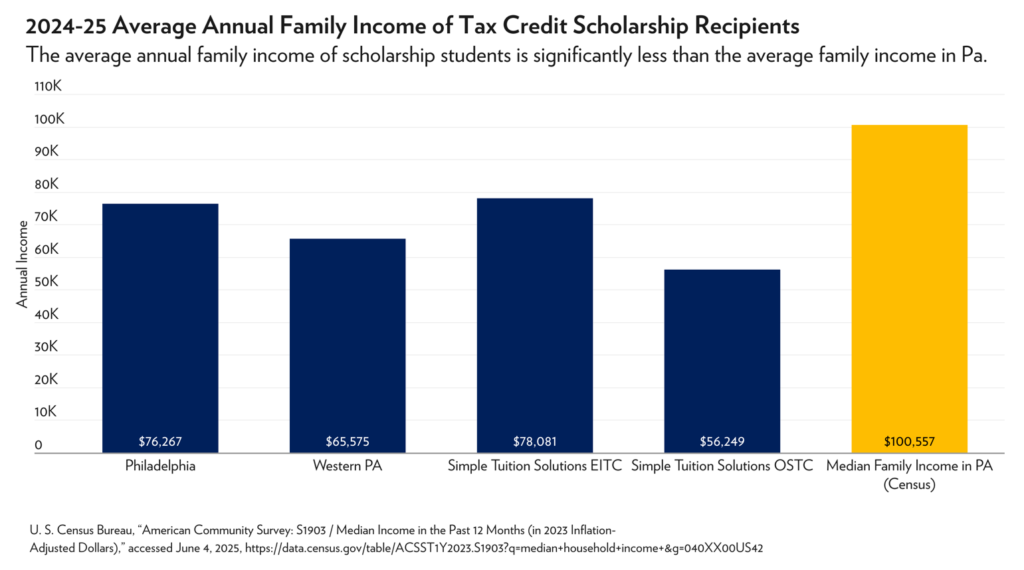
- The Commonwealth Foundation compiled data from the Archdiocese of Philadelphia and Simple Tuition Solutions (STS) to provide insight into the students served by the programs during the 2024–25 school year.
- Data from the Archdiocese of Philadelphia, which serves the five-county Philadelphia region, demonstrates that most families receiving tax credit scholarships earn an average of $76,267 per year, below the median income level of $100,557 for Pennsylvania families.
- STS data shows an average household income of $78,081 for EITC scholarship recipients and $56,249 for OSTC recipients.
Increasing Demand for School Choice
The most recent data (i.e., the 2023–24 school year)—obtained by the Commonwealth Foundation from the Department of Community and Economic Development (DCED) through Right to Know (RTK) requests—reveal the current impact of Pennsylvania’s tax credit scholarship programs.
- In 2023–24, K–12 students submitted 169,776 scholarship applications, 5,227 more than the previous year and the highest on record.
- OSTC applications reached 61,366, but only 15,517 students received scholarship awards; 75 percent, or 48,849 applicants, all of whom reside within a low-achieving public school district, were denied scholarships.
- In 2023–24, the average K–12 tax credit scholarship was $2,776 per student, up $117 compared to the previous year.
- Scholarship organizations awarded 101,751 K–12 scholarships in 2022–23, up 16,181 from the previous year.
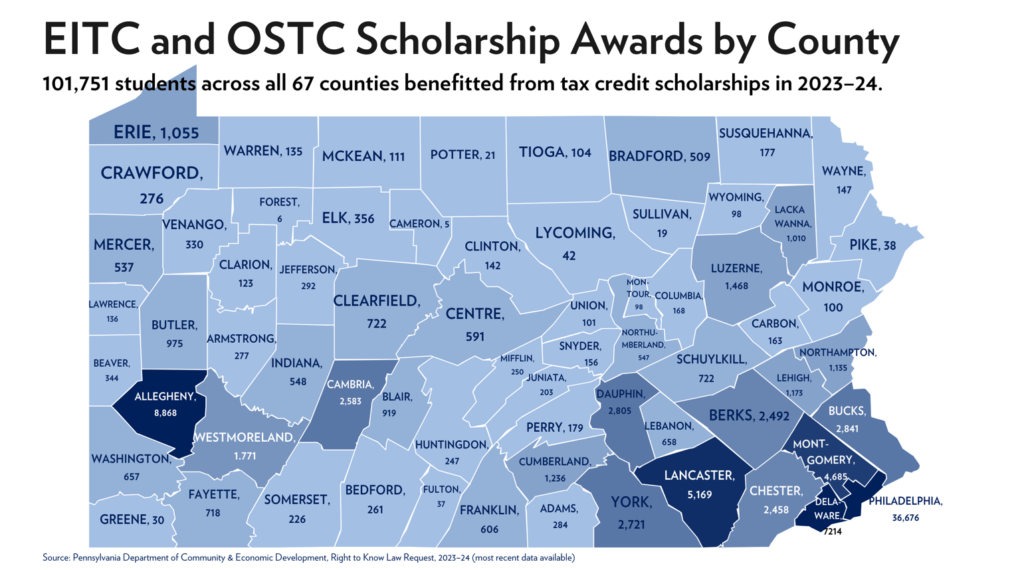
- Students attend K–12 private schools on EITC or OSTC scholarships in all 67 counties.
- However, the RTK data shows demand continues to far outpace supply. EITC and OSTC program caps failed to fund 68,817 student scholarship applications.
Policy Recommendations
While Pennsylvania’s tax credit scholarship programs provide transformative opportunities to over 100,000 students, demand continues to exceed supply.
Increase funding to end the waitlist for scholarships.
- The 2025–26 state budget flat funded EITC and OSTC scholarships, but increased the Economically Disadvantaged Schools (EDS) portion of EITC by $50 million. This increase, not yet reflected in the donation or scholarship data, will provide thousands of additional scholarships at higher dollar values. Still, this increase falls far short of the demand for scholarships, demonstrating the requirement for additional funding to keep pace with student need.
- Passing legislation for an “automatic index” would allow the tax credit scholarship programs to grow alongside student need. Proposals, such as Senate Bill 527 introduced in 2022, would increase each program by 25 percent annually when 90 percent of available tax credits are allocated in the previous year.[4]
Pass legislation to expand educational opportunity in Pennsylvania.
The unmet demand for EITC and OSTC programs demonstrates that Pennsylvania families want school options beyond the traditional public school.
- Tax dollars should follow students to the school of their choice, whether that is public, private, charter, career and technical, or home education programs.
- The Lifeline Scholarship Program,[5] if passed, would provide approximately 13,000 scholarships for every $100 million appropriated to the more than 200,000 students stuck in Pennsylvania’s failing district schools to attend the private school of their choice.[6]
- The proposed Learning Investment Tax Credit would provide an $8,000 per child refundable tax credit to offset education expenses for children attending a non-public school.
- Both programs would fund students at far less than the $23,061 public schools spend per student.[7]
- Pennsylvania lawmakers must ensure that Pennsylvania opts in to the FSTC, passed by Congress in July 2025.[8] This brand new program, starting in 2027, will allow anyone with IRS tax liability to donate up to $1,700 annually through one of Pennsylvania’s existing Scholarship Organizations to provide scholarships to cover educational expenses for public, private, and possibly homeschool students.
- The FSTC has uncapped revenue potential with expectations to generate $967 million annually, with failing to opt in costs projected to hit $1.9 billion by 2029.[9]
- But first, Pennsylvanians need Gov. Josh Shapiro’s FSTC opt in before January 1, 2027.
[1] Pennsylvania Department of Community & Economic Development (DCED), “Scholarship Organizations: List of Scholarship Organizations Effective 01/01/2024 – 12/31/2024 (EITC),” accessed January 31, 2025, https://dced.pa.gov/scholarship-organizations/.
[2] Pennsylvania Department of Community and Economic Development (DCED), “Educational Improvement Tax Credit Program: Organization Guidelines and Application for Scholarship and Educational Improvement Organizations,” (Harrisburg: September 26, 2024), 2, https://dced.pa.gov/download/eitc-organization-guidelines/?wpdmdl=84187.
[3] Pennsylvania Department of Community and Economic Development (DCED), “Opportunity Scholarship Tax Credit Program (OSTCP),” accessed January 31, 2025, https://dced.pa.gov/programs/opportunity-scholarship-tax-credit-program-ostc/; Pennsylvania Department of Education, “Opportunity Scholarship Tax Credit Program: Low Achieving Schools,” accessed January 31, 2025, https://www.education.pa.gov/K-12/Opportunity%20Scholarship%20Tax%20Credit%20Program/Pages/default.aspx.
[4] Sen. Mike Regan, Senate Bill 527, Pennsylvania General Assembly, Regular Session 2021–22, https://www.legis.state.pa.us/cfdocs/billInfo/billInfo.cfm?sYear=2021&sInd=0&body=S&type=B&bn=527.
[5] Commonwealth Foundation, “PASS/Lifeline Scholarship Program,” May 5, 2025, https://commonwealthfoundation.org/research/lifeline-scholarship-program-pass/.
[6]The state Senate passed Lifeline Scholarships, codified as the Pennsylvania Award for Student Success (PASS), multiple times during the 2023–24 legislative session, which Governor Shapiro line-item vetoed from the 2023–24 budget and the House excluded from the 2024–25 budget deal. Meanwhile, the 2025–26 session has two separate but similar initiatives: the PASS scholarship program (Senate Bill 10) and Lifeline Scholarships (House Bill 1489). Each would provide tuition scholarships of up to $10,000 per student for kids residing in catchment areas of low-achieving public schools. See: Sen. Judy Ward et al., Senate Bill 10, Pennsylvania General Assembly, Regular Session 2025–26, https://www.legis.state.pa.us/cfdocs/billinfo/bill_history.cfm?syear=2025&sind=0&body=S&type=B&bn=10; Rep. Clint Owlett, House Bill 1489, Pennsylvania General Assembly, Regular Session 2025–26, https://www.palegis.us/legislation/bills/2025/hb1489; Commonwealth Foundation, “Underserved Students Face Uncertain Future Following Gov. Shapiro’s Budget Decision,” news release, August 3, 2023, https://commonwealthfoundation.org/2023/08/03/shapiro-budget-decision/; Commonwealth Foundation, “2024–25 State Budget Analysis,” July 12, 2024, https://www.commonwealthfoundation.org/research/2024-25-pa-state-budget-analysis/.
[7] Commonwealth Foundation, “Pennsylvania School Funding Reaches $23,000 per Student in 2024,” May 15, 2025, https://commonwealthfoundation.org/research/pennsylvania-school-funding-reaches-record-level/.
[8] Public Law No. 119-21 § 70411, 139 Stat. 72 (2025); Commonwealth Foundation, “Federal Scholarship Tax Credit,” February 23, 2026, https://commonwealthfoundation.org/research/federal-scholarship-tax-credit/.
[9] Democrats for Education Freedom, “New PA Poll: 78% of Keystone State Voters Support Opting Into the Federal Scholarship Tax Credit (FSTC),” news release, November 25, 2025, https://dfer.org/2025/11/25/new-pa-poll-78-of-keystone-state-voters-support-opting-into-the-federal-scholarship-tax-credit-fstc/; America First Policy Institute, “The Cost of Option Out,” accessed April 13, 2026, https://afpieftc.netlify.app/.