Testimony

Pennsylvania Students Will Thrive With Educational Choice
Testimony of Stephen Bloom, Vice President
Commonwealth Foundation
Pennsylvania House Republican Policy Committee
Hearing on Educational Choice in the Commonwealth
January 23, 2026
Chairman Rowe and members of the committee:
Thank you for the invitation to testify and for your attention to this issue.
My name is Stephen Bloom. I am the Vice President of Commonwealth Foundation for Public Policy Alternatives, a free-market think tank that advances policy solutions to empower all Pennsylvanians thrive. And I’m joined this morning by my Commonwealth Foundation colleague, Rachel Langan, our Senior Education Policy Analyst.
At the Commonwealth Foundation, we believe that Pennsylvania’s educational policies should prioritize fairness, transparency, accountability, and the opportunity for every child to access a high-quality education, regardless of their zip code.
Introduction
Pennsylvania has been and remains a leader in educational choice. In 2023–24, the latest year for which data are available, Pennsylvania tax credit scholarship programs served more than 101,000 low-income K–12 students. In sheer volume, the only states that serve more students through educational choice programs are Florida and Arizona.
Additionally, the Federal Scholarship Tax Credit (also known as ECCA, or the Educational Choice for Children Act), enacted in July 2025, will expand tax credit scholarships to all 50 states. This new program is modeled, in part, on Pennsylvania’s tax credit scholarship programs: the Educational Improvement Tax Credit (EITC) and the Opportunity Scholarship Tax Credit (OSTC).
Our commonwealth—a purple state—has the opportunity to lead the nation by expanding educational freedom by opting into the federal scholarship program by the end of 2026.
Pennsylvania’s Experience with Tax Credit Scholarships
Since enacting the EITC in 2001 and the OSTC in 2012, Pennsylvania has served tens of thousands of low- and middle-income students annually through a decentralized, donor-funded scholarship model.
Pennsylvania is currently home to more than 250 scholarship organizations that administer EITC and OSTC scholarships.
In the 2023–24 school year, Pennsylvania scholarship organizations awarded 101,000 K–12 scholarships, with average scholarships, as of 2023, amounting to $2,613 for EITC and $2,705 for OSTC.
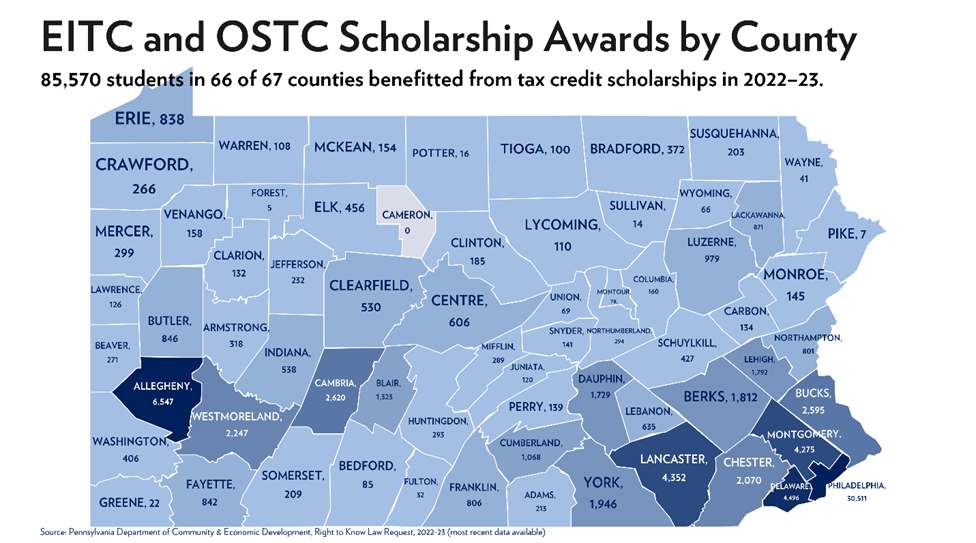
These scholarships serve students in 66 of 67 counties in Pennsylvania and cost a fraction of the per-pupil spending in traditional public schools.
Data collected by the Commonwealth Foundation over the past two years finds that the median tuition of schools serving EITC and OSTC students was less than $10,000 (with average family contribution less than $7,000) in 2023, proving that even small scholarships can make a significant impact on the affordability of private education for low-income families.
While the income limits under EITC and OSTC allow middle-class families to participate, the scholarships primarily serve low-income students.
- FACTS, a division of the National Education Loan Network (or Nelnet), provides private K–12 schools with application, financial aid, and tuition management services. Data provided by FACTS showed an average household income of $41,463 for EITC and OSTC scholarship recipients across the state.
- Simple Tuition Solutions (STS) provides tuition management and financial aid assessment software for private K–12 schools and scholarship organizations in Pennsylvania. STS data showed that the average household income was $73,100 for EITC scholarship students and $54,500 for OSTC scholarship recipients across the state.
That is, the average family income of scholarship recipients was well below the statewide median family income of $93,000 in 2023.
State law now requires scholarship organizations to spend at least 90 percent of EITC and OSTC donations on scholarships. However, even before this change, the vast majority of Pennsylvania scholarship organizations were already exceeding this threshold.
- EITC scholarship organizations spent an average of 93.8 percent of their funds on scholarships.
- OSTC organizations averaged 94.5 percent on scholarships.
- More than 75 percent of Pennsylvania scholarship organizations awarded more than 90 percent of their donations through scholarships.
Families Need More Options
Despite the success of the EITC and OSTC, Pennsylvania families want additional choices.
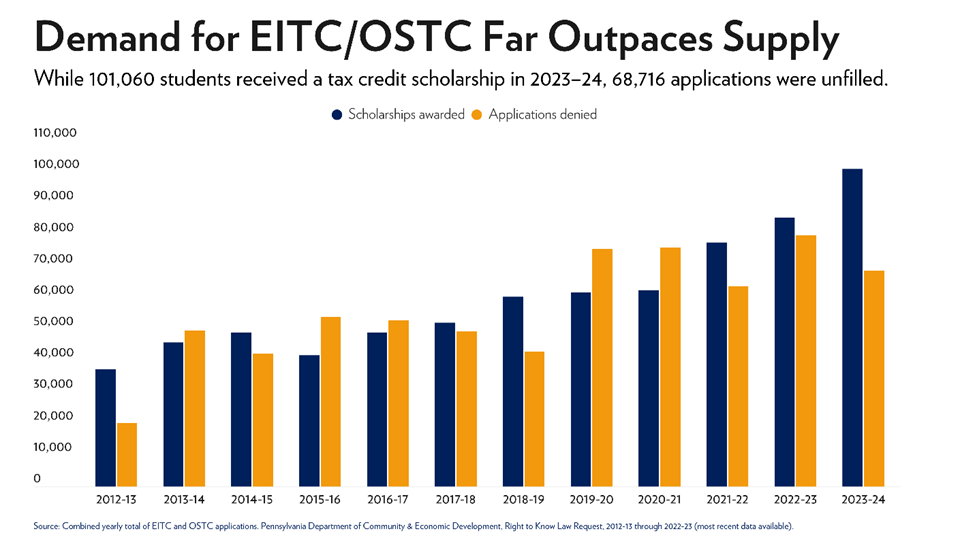
Demand exceeds supply for Pennsylvania’s tax credit scholarship programs. As mentioned previously, EITC and OSTC provided partial tuition scholarships for 101,000 low-income students in the 2023–24 school year. However, due to program and funding limitations, 69,000 scholarship applications were turned away, leaving tens of thousands of kids on waiting lists. The demand for tax credit scholarships shows that Pennsylvania families want and need expanded school choice programs. Increasing funding for EITC and OSTC is vital for meeting the needs of low-income families in Pennsylvania.
Additionally, tens of thousands of students remain on charter school wait lists in Philadelphia alone.
According to the Pennsylvania Department of Education, the number of homeschool students in Pennsylvania has increased by 72 percent since the COVID-19 Pandemic.
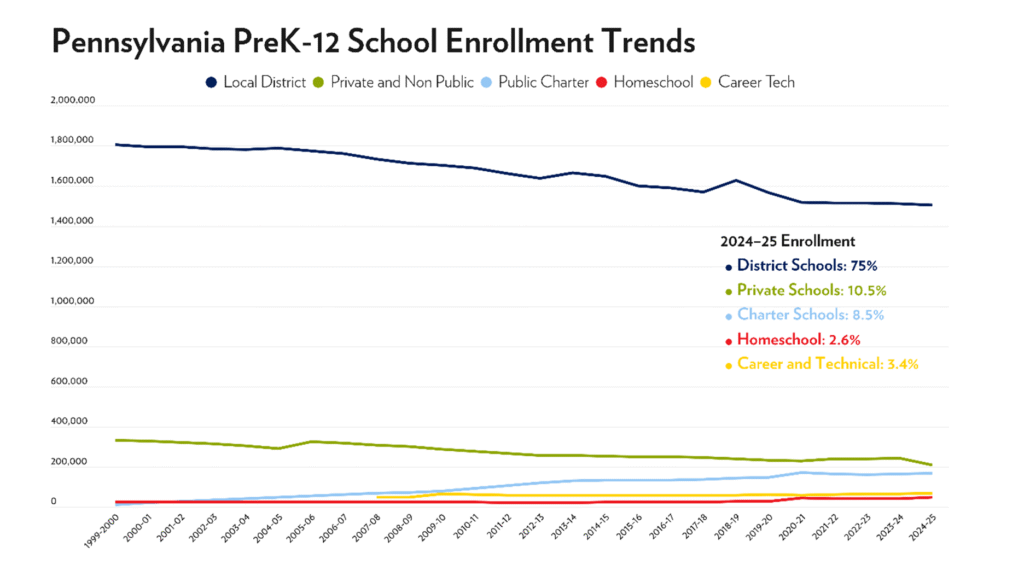
Ten percent of all school-aged children in Pennsylvania—210,000 students—attend private schools.
Unfortunately, there are just as many students (211,000) attending the commonwealth’s 383 low-achieving, dangerous, chronically failing, ZIP-code-assigned public schools.
In fact, 141 of all failing schools statewide (or about 37 percent) are right here in Philadelphia.
This means that there are 63,000 students—sitting in classrooms right now in Philadelphia— where test scores are amongst the lowest in the state. Many of these schools have been low-achieving for more than six years in a row. Kids attending these low-achieving schools have never had the opportunity to experience a high-quality education.
The new Federal Scholarship Tax Credit could make a real difference by providing tuition assistance for hundreds of thousands of kids so they can transfer out of low-achieving schools. Homeschoolers and even kids attending public schools will be able to receive scholarships to cover tutoring, books, music lessons, summer camps, and special education-related expenses.
This program would expand educational opportunities in Pennsylvania at no cost to the state. The funding source would be private donors, so current funding streams to public education would remain intact.
The Federal Scholarship Tax Credit Program
The federal scholarship tax credit allows any taxpayer to donate up to $1,700 for donations to scholarship-granting organizations and receive a tax deduction for their generosity. Pennsylvania already has more than 250 scholarship-granting organizations that can hit the ground running to implement this new program.
While Congress passed the federal scholarship tax credit in 2025, the U.S. Treasury and the Internal Revenue Service (IRS) are working through the formal rulemaking process involving public comment, and the first reading of the rules is expected by the end of March 2026.
Under the federal scholarship tax credit, donors will be able to give beginning in 2027 and receive a nonrefundable tax credit for 100 percent of their donation, up to $1,700. Donations would go to scholarship-granting organizations that could provide scholarships to cover tuition, fees, tutoring, special needs services, books, supplies, and required equipment for eligible students at private or public schools. The scholarship organizations would determine the number of scholarships
An analysis from Education Reform Now suggests that if even 15 percent of Pennsylvania taxpayers with a federal tax liability of greater than $1,700 participate, that would yield $484 million in donations.
However, for Keystone State students to benefit, Pennsylvania must opt in by the end of 2026. This federal law says governors—or agencies, as directed in state law—can opt in by simply providing a list of eligible scholarship-granting organizations in the state. While the IRS already has a form for governors to make an advance election, Governor Shapiro has thus far not indicated his intent to opt in.
According to recent polling, seven out of 10 Pennsylvanians want our governor to opt in to the new program.
Even if Governor Shapiro refuses to opt in, though, Pennsylvania taxpayers would still be able to take the tax credit and donate to scholarship-granting organizations in other states. By not opting in, the Keystone State would lose out on hundreds of millions of dollars.
Conclusion
This year provides a unique opportunity for lawmakers to deliver on the educational options parents demand.
First, state lawmakers must work with the governor to ensure that Pennsylvania opts in to the federal scholarship tax credit program. Failure to do so would result in millions of dollars leaving Pennsylvania and leaving kids in the lurch.
Lawmakers should also increase caps on the EITC and OSTC programs to keep up with demand and help ensure every child in Pennsylvania receives a high-quality education, regardless of their zip code.
Finally, Pennsylvania lawmakers should embrace the recent successes in other states. In just the past few years, more than a dozen states have adopted universal educational choice programs through educational scholarship accounts or refundable tax credits. To compete in attracting families and delivering the best educational options for our children, the Keystone State needs to follow suit.
Again, thank you. I would be happy to address any questions you may have.