Report

The Battle for Worker Freedom: How Government Unions Fund Politics Across the Country
Key Findings
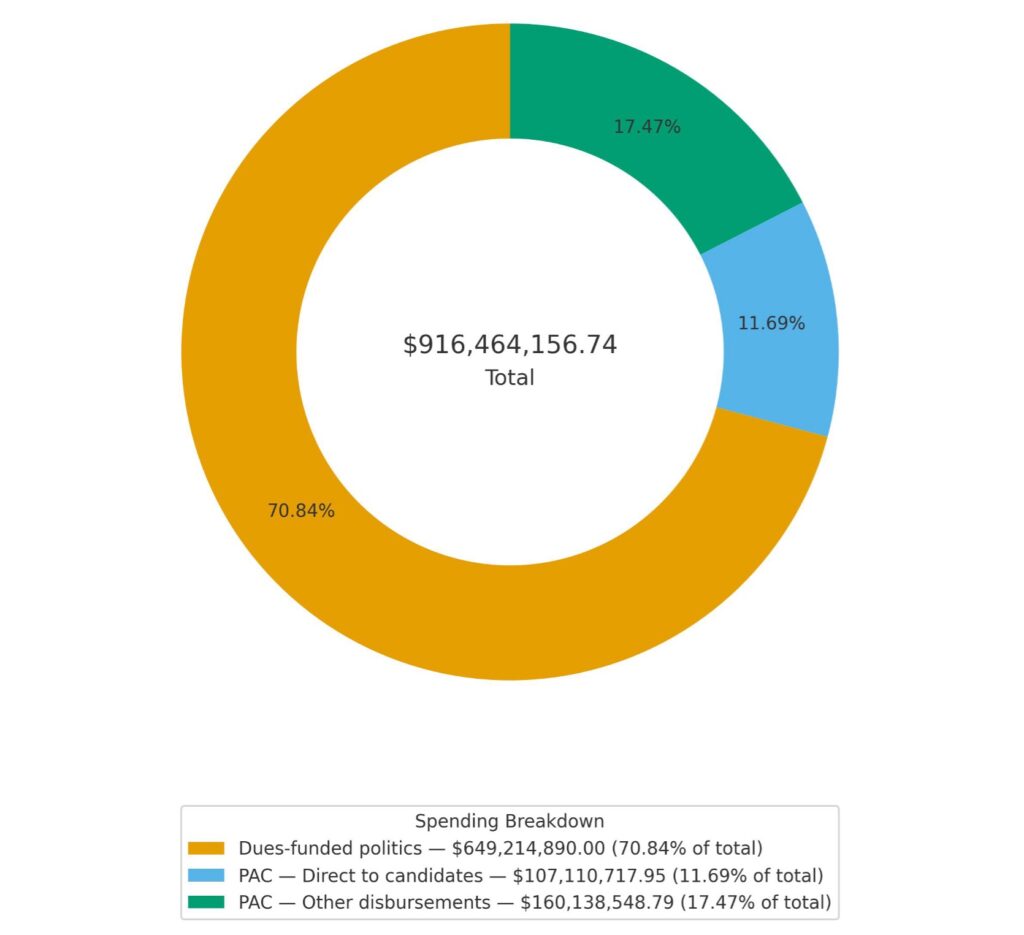
- During the 2023–24 election cycle, the four biggest public sector unions—the National Education Association (NEA), American Federation of Teachers (AFT), Service Employees International Union (SEIU), and American Federation of State, County and Municipal Employees (AFSCME)—combined spent over $915 million in partisan elections and advancing progressive ideology.
- The NEA, AFT, SEIU, and AFSCME collectively spent $755 million on federal elections and national progressive politics, and their state-level affiliates combined to spend another $160 million on state races and ideological causes.
- Of the money spent on national politics by the NEA, AFT, SEIU, and AFSCME, 86 percent (nearly $650 million) came from member dues. Meanwhile, unions’ federal PAC dollars accounted for 14 percent of political spending, with just 2 percent of overall union political spending going directly to candidates.
- Government unions’ heavy use of membership dues money for politics—more than what they collectively spent on representational activities—underlines a disturbing trend: the growing, overt reliance by union officials to spend member dues rather than political action committee funds on their political and ideological agendas.
- Together, the NEA, AFT, SEIU, and AFSCME spent $488 million of members’ dues driving Democratic politics, economic redistribution, critical race theory, defunding the police, promoting abortion, and opposing school choice.
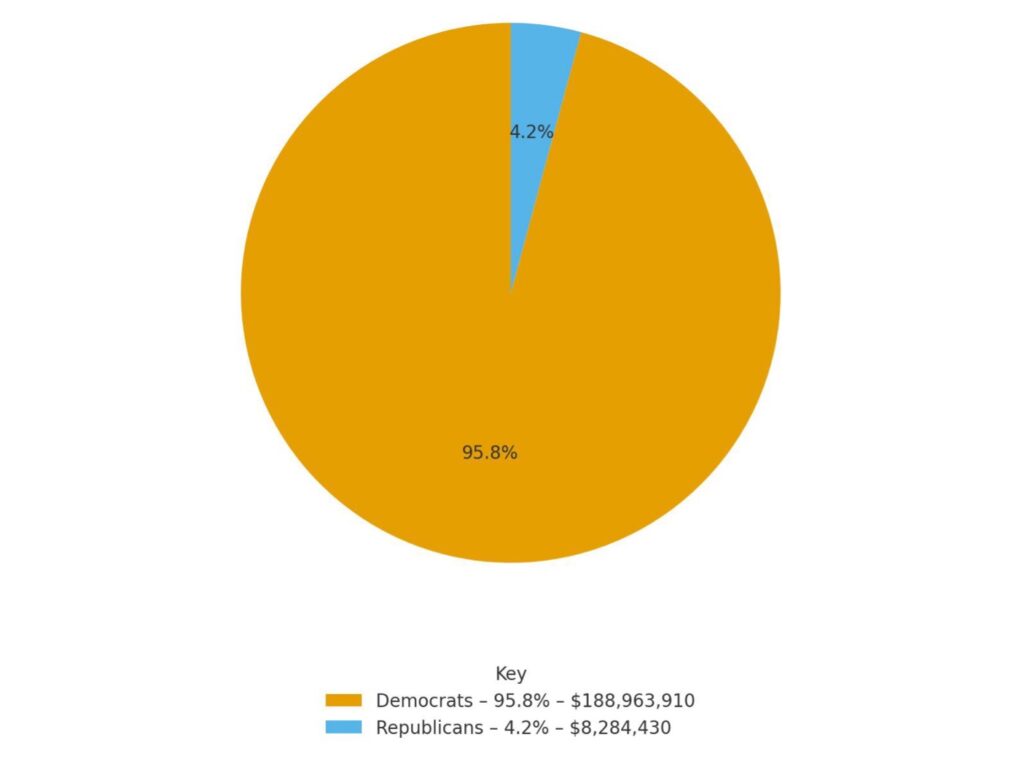
- The NEA, AFT, SEIU, and AFSCME sent over $107 million directly to candidates for federal, state, and local office, with 95.8 percent going to Democrats and just 4.2 percent to Republicans.
- Over the 2023–24 federal election cycle, national PACs operated by the NEA, AFT, SEIU, and AFSCME collectively contributed over $106 million to candidates for office, party committees, and political committees. President Joe Biden’s campaign, replaced by Vice President Kamala Harris’s bid for the White House in 2024, received almost $5 million in support from just these four unions.
- Public sector unions affiliated with the NEA, AFT, SEIU, or AFSCME invested politically in every state, yet, in just five—Illinois, California, Washington, Massachusetts, and Pennsylvania—the spending accounted for nearly two-thirds ($105 million) of overall state-level union PAC outlays.
- Illinois’ public sector union officials, at $29.9 million, spent the lion’s share, totaling more than what government unions spent in the bottom 41 states combined.
- In 2023, Chicago Mayor Brandon Johnson, alone, received over $5.5 million from the NEA, AFT, SEIU, AFSCME, and their affiliates.
Executive Summary
The Commonwealth Foundation initiated this biennial publication examining public sector union political spending in December 2023, as part of its “Battle for Worker Freedom” research series. The second edition of “How Public Sector Unions Fund Politics across the Nation”—similar to the first—uses publicly available data, including federal and state campaign finance reporting and union LM-2 filings to track membership dues and PAC money spent by government unions to influence political campaigns and public policy in state and federal governments during the most recent available reporting period—2023 through 2024.
On the national stage, union political spending during the 2023–24 election cycle shows union executives’ marked preference for independent expenditures and issue advocacy—using membership dues—and away from traditional PAC spending. In fact, of the money spent on politics by the NEA, AFT, SEIU, and AFSCME, 86 percent (~$650 million) came from members’ dues, while 14 percent (~$106 million) came from union PAC dollars. Even then, the overwhelming majority of all union PAC dollars went to other party and political committees, with just 2 percent of overall spending going directly to candidates.
On the state level, campaign finance reports reveal another $160.9 million in government union PAC spending. Most of this spending—nearly $91 million—went to partisan politics (i.e., parties, party-managed PACs, and partisan candidates for state and local offices), while $70 million went to nonpartisan PACs and candidates running for nonpartisan offices.
2023–24 Government Union Political Spending[1]
These unions’ donations to political candidates were heavily skewed in favor of Democrats, with 95.8 percent going to Democrats and just 4.2 percent to Republicans. This imbalance was especially evident on the national level, where the NEA, AFT, SEIU, and AFSCME sent 98.8 of their donations to Democrats and a mere 1.2 percent to Republicans.
Party Breakdown of Federal, State, and Local Partisan Candidates Receiving Government Union PAC Money, 2023–24 Cycle.[2]
Several factors may explain union officials’ willingness to spend big on politics using membership dues money, even despite the potential for member backlash. First, general treasury fund spending—used politically for independent expenditures, issue advocacy, and non-electoral politics—is not subject to the contribution limits that cap PAC outlays in federal elections and many states. Second, and relatedly, general fund dollars offer greater flexibility to union officials, who can choose whether to deploy them for politics—as independent expenditures in a particular election, as support for the broader leftist political infrastructure, or as donations to progressive charities pushing social issues outside of formal politics—or not at all. Third, general funds are far easier to raise than PAC dollars. And finally, union members find it harder to hold union executives accountable for political spending using membership dues relative to PAC spending.
Conclusion
The country’s largest public sector unions drive elections and fund an expansive progressive ecosystem, influencing state and national politics in and out of election years. During the 2023–24 election cycle, the four biggest public sector unions—NEA, AFT, SEIU, AFSCME, and their state-level affiliates—combined to spend over $915 million in elections and progressive politics.
Yet, much of this spending is possible only because of the lack of accountability and control over what powerful union executives do with members’ dues. Union dues, not the separately collected PAC funds, are the overwhelming power behind—86 percent—of union political spending. Few members are aware that union leaders launder much of their dues through super PACs and 527s to back political projects. Even fewer members can effect change within their union to stop it.
[1] U.S. Federal Election Commission, Campaign Finance Data, accessed October 15, 2025, https://www.fec.gov/data/; Open Secrets, Organization Profiles, accessed October 10, 2025, https://www.opensecrets.org/orgs/all-profiles.
[2] Campaign finance reports filed by the NEA, AFT, AFSCME, and SEIU with the U.S. Federal Elections Commission and those filed by their affiliated unions with the responsible campaign finance reporting entity in each state.