Stay Informed
"*" indicates required fields
Blog

Pinching Pennies: How Government Intervention in Health Care Failed
Pennsylvania’s Affordable Care Act (ACA) marketplace, Pennie, has—despite its name—an affordability problem. Premiums and out-of-pocket costs keep rising despite—or rather because of—the government’s attempt to control both.
The common explanation is that greed and the free market are to blame. But there is no free market for health care. Pennie operates entirely within boundaries that the government sets: what insurers can provide, how much rates can rise year after year, and who qualifies for subsidized coverage. If greed is driving up costs, it’s operating within a system built by regulators, not by market forces.
For Pennie, Pennsylvania’s Insurance Commission caps how much premiums may rise each year—a form of price control. Price controls don’t reduce care-delivery costs; they prevent the premiums from reflecting the actual expenses. Those costs don’t disappear. They show up elsewhere: higher deductibles, narrower provider networks, more prior-authorization denials, etc. Enrollees pay more out-of-pocket costs or higher taxes.
Overregulation also pushes insurers out of the market entirely. Aetna, part of CVS Health, exited the ACA individual marketplace after projecting a steep $400 million loss under current plan requirements. Fewer insurers mean less competition, and less competition is one reason health care is unaffordable in the first place. A price cap doesn’t fix that; it just thins the field of insurers that would otherwise compete for customers on price and quality.
The ACA also requires every marketplace plan to cover a fixed list of benefits whether an individual enrollee needs them or not. This mandate drives up premiums and costs because insurers can’t offer cheaper plans to attract price-sensitive customers. The government mandates what a plan must include. That takes away one of the simplest ways a market normally keeps prices in check: letting people choose to pay for less.
Subsidies make this worse, not better. When government covers part of the premium, insurers have less incentive to keep prices down because taxpayers absorb the difference rather than the enrollees. That’s not a lower cost; it’s the same cost—but paid through taxes instead of premiums.
The ACA exchanges provide advanced premium tax credits to lower income households and during the pandemic extra enhanced subsidies to everyone. The latter were intended to be temporary and expired at the end of 2025. Enrollment is now returning to its natural, pre-pandemic. That shift raises the average cost for everyone left in the risk pool, and premiums rise to match it, even under a government “cap.”
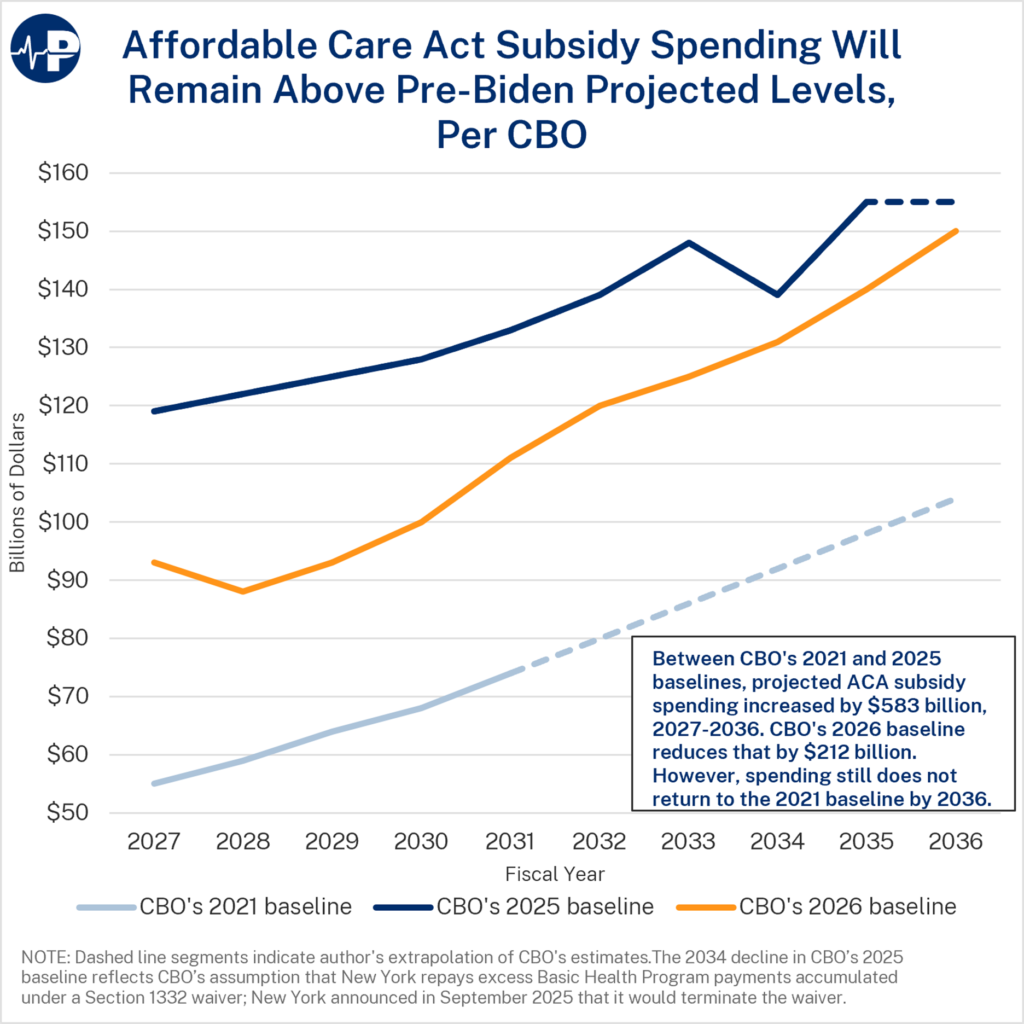
Critics often point the finger of blame at the One Big, Beautiful Bill (OBBB) for dwindling enrollment. But the OBBB, as designed, doesn’t cut spending, as claimed by many. Instead, it slows the rate at which spending grows. Analysis by the Paragon Institute shows that the Congressional Budget Office (CBO), the agency responsible for fiscal projections on federal revenue, projects the current baseline for ACA subsidies will be higher than in 2021 under President Joe Biden.
So, what is left to do? How can lawmakers provide genuinely affordable health care?
Rather than direct more tax dollars to a failed system, Pennsylvania lawmakers should pursue reforms that restore choice and competition: allow renewable short-term insurance plans, grant full practice authority to nurse practitioners, protect Direct Primary Care arrangements, and enforce existing hospital-price transparency.
To learn more, review some of the Commonwealth Foundation’s recent research and commentary on a free-market approach to health care:
- Personal Option Needed
- Obamacare Did Not Lower Costs. It Is Time for a Better Approach
- The Personal Option for Health Care in Pennsylvania
Connect With Us
Email Sign Up
"*" indicates required fields