Fact Sheet
Assessing Gov. Shapiro’s GRID Requirements
Summary
- The “Governor’s Responsible Infrastructure Development” (GRID) Requirements apply to data centers over 25 megawatts (MW). The standards give municipalities no new authority over noise, water withdrawal, traffic, or setbacks; instead, they layer state mandates on top of existing municipal authority.
- GRID Requirements impose mandates for buying certain types of energy, similar to the commonwealth’s existing Alternative Energy Portfolio Standards (AEPS). A rising share of a project’s electricity must come from new state-approved “clean firm” sources located in Pennsylvania: 10 percent by 2027, 14.5 percent by 2030, and 32 percent by 2035.
- Noncompliance penalties, decided by project, range from $25,000 to $100,000 per MW of rated capacity per day. Signers waive the right to appeal Pennsylvania Department of Environmental Protection (DEP) decisions, including such penalties to the Environmental Hearing Board.
- Shortfall payments go to the Pennsylvania Energy Development Authority to subsidize solar and other state-approved sources.
- The GRID Requirements extend prevailing wage to privately financed construction and set a $250 million spending floor that functions as a minimum project size.
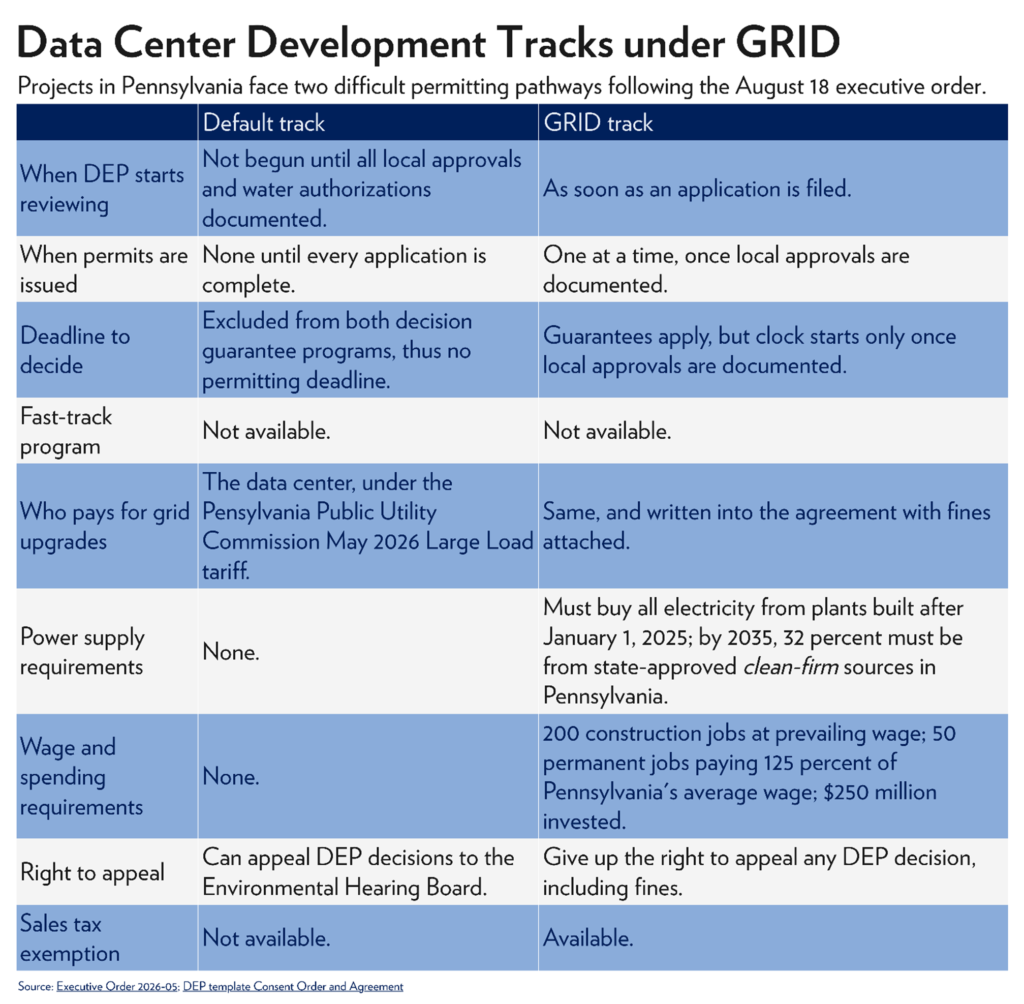
- The outcomes of GRID’s two permitting tracks are at the discretion of the DEP. Developers who decline the consent order lose the permit deadlines and money-back guarantees that GRID-compliant signers retain: DEP will not begin review until every local approval is documented, and it will not issue any permit until all are approved.
- In June 2025, Gov. Josh Shapiro called Amazon’s $20 billion the largest private investment in state history and cut permit wait times to win it. Fourteen months later, he removed every data center from Fast Track and made permit deadlines conditional on a consent order.
- The General Assembly did not enact House Bill (HB) 2650; Shapiro has imposed GRID by executive order. GRID’s sound parts, cost causation, government transparency, and resource use reporting, belong in statute. The rest is overreach, and regulations should come from the legislature or local municipalities.
Introduction
Pennsylvania has 174 existing data centers and has hosted data centers for decades, including server rooms for banks and hospitals, colocation facilities, and county 911 centers.[1] What is new is scale: hyperscale data center campuses draw 100 to more than 1,000 MW. According to an independent tracker, five hyperscale projects are under construction in the state, and there are others proposed, but—with GRID governing projects above 25 MW—it remains to be seen how many and which ones will become operable.[2]
In June of 2025, Shapiro lauded Amazon’s commitment of at least $20 billion to build hyperscale data center campuses in Luzerne County and Bucks County.[3] A year later, Pennsylvanians are increasingly wary of hyperscale development.
GRID Timeline
Shapiro announced the GRID Requirements on February 3, 2026; since then, the standards have gone through several modifications, but their overall direction remains the same.
- 2021: Pennsylvania enacts the sales and use tax exemption for computer data center equipment.[4]
- November 19, 2024: Shapiro establishes a project-based permitting “Fast Track” program for complex and impactful economic development and infrastructure projects.[5]
- June 9, 2025: Shapiro calls Amazon’s commitment of at least $20 billion “the largest private sector investment in the history of Pennsylvania.”[6] Shortly after, the administration took steps to eliminate red tape and reduce processing times for data center permits.[7]
- February 3, 2026: As part of the 2026–27 Executive Budget Proposal, Shapiro announces the GRID Requirements.[8]
- May 1, 2026: The administration removes the Archbald data center campus (Project Gravity) from the PA Permit “Fast Track” program.[9]
- May 13, 2026: The Public Utility Commission (PUC) releases its final Large Load Model Tariff, applying cost causation to large electric loads, such as data center interconnection.[10] The GRID Requirements later adopt it as the minimum standard.
- May 27, 2026: The Department of Community and Economic Development (DCED) publishes the GRID Standards.[11]
- June 2026: The House passes HB 2650, the legislative version of GRID standards. The Senate passes data center transparency requirements and votes to repeal the data center equipment sales tax exemption.[12]
- July 2026: The 2026–27 state budget requires data centers using more than 10 MW to disclose energy and water use, yet it does not include HB 2650 nor the sales tax repeal.[13]
- August 18, 2026: Executive Order 2026-05 enacts a new version of GRID standards.[14] The DEP publishes a template Consent Order and Agreement.[15] All data centers are removed from “Fast Track.”
GRID Executive Order Requirements
Before August 18, a data center permit worked like any other. The DEP started reviewing when the application came in and issued permits as it approved them. Two programs required a decision by a set date or a refund of the fee.[16] Separately, nine data centers had been admitted to Pennsylvania’s “Fast Track” program.[17]
Shapiro’s executive order ended all of that. Every data center lost fast-track eligibility, and developers who decline to sign onto the GRID consent order lose both decision guarantees. Declining leaves a project worse off than where it started before the order.
The order results in two tracks for data center projects over 25 MW. Both tracks consolidate power in the Pennsylvania executive, giving wide discretion to the DEP.
Default Track: Developers must first obtain and document all local approvals and any water withdrawal or wastewater authorization. This track specifically removes data center permits from existing permitting timelines and decision guarantees requiring a decision by a specified date. Additionally, it excludes data centers from the PAyback program, which offers a money-back guarantee if permits are not processed on time. DEP shall not issue permits until all applications have been received and reviewed.[18] Under this scenario, one state permit can be in limbo indefinitely.
GRID Track—Developers sign a binding consent order with the DEP:
- Waivers of permit review: GRID signers waive the right to contest the DEP’s findings, to challenge the agreement’s content or validity, and to appeal any departmental decision to the Environmental Hearing Board. Signers also waive the ability to challenge the department’s inclusion of GRID obligations for permitting in any forum.[19]
- Infrastructure costs: The developer must pay, through base rates, surcharges, or other ratemaking mechanisms, interconnection costs, including transmission, distribution, and network upgrades where those costs are directly attributable to serving the project, or would not have been needed but-for its demand. Compliance may be demonstrated through an electric service agreement on terms no less stringent than the PUC’s Large Load Tariff.[20]
- Electricity costs: The developer must serve its energy demand with new generation placed in service on or after January 1, 2025, and the power source must be located within the same PJM Locational Deliverability Area or secure a delivery contract.[21]
- Energy Mandate: As a subset of a data center’s electricity supply, GRID imposes an AEPS-like purchase mandate.[22] A rising share of the project’s annual electricity consumption must come from newly built government-approved “clean firm” sources located in Pennsylvania:
- Beginning January 1, 2027, 10 percent.
- Beginning January 1, 2030, 14.5 percent.
- Beginning January 1, 2035, 32 percent.
- Under the department’s template Consent Order and Agreement, qualifying sources currently include nuclear, hydroelectric (including pumped storage), geothermal, fuel cells, solar, wind, clean hydrogen, battery storage, distributed energy resource aggregations, and long-duration storage.[23] Shortfalls are paid to the Pennsylvania Energy Development Authority (PEDA) by June 1 each year at the Energy Information Administration’s levelized cost for unsubsidized solar.[24]
- Penalties: Noncompliance with the energy obligations carries stipulated civil penalties of $25,000 to $100,000 per megawatt of rated capacity per day, which the DEP would decide for each agreement. All other violations run $25,000 per day. Penalties are due automatically and without notice.[25]
- Workforce: GRID requires at least 200 construction jobs at prevailing wage, as well as 50 permanent jobs at 125 percent of the statewide average wage by the fourth year of operation. Following that, GRID mandates $1.5 million in annual site payroll.[26]
- Pennsylvania’s Prevailing Wage Act governs public construction, but GRID extends the prevailing wage to privately financed projects as a condition of permitting.[27] Prevailing wage rates run 30 to 76 percent above market rates across the commonwealth, and because the fringe benefit calculation applies differently to union vs. non-union shops, it disadvantages non-union contractors.[28]
- Minimum investment: GRID requires at least $250 million in cumulative new investment. The definition counts construction, electrical infrastructure, and cooling but excludes computer servers, networking equipment, and software. Effectively, this functions as a minimum project size.[29]
- Community agreements: GRID requires a community outreach plan, public meetings, and a community benefit agreement offered to municipal and county governments within 60 days, addressing noise, vibration, lighting, traffic, air quality, and aesthetics.[30]
- Data center equipment Sales and Use tax exemption: Tax exemptions are reserved for GRID-compliant projects beginning on or after August 18, 2026.[31]
Issues Outside of GRID
Capacity and reliability costs: GRID’s incremental capacity requirement addresses new demand from Pennsylvania projects that sign. It cannot reach hyperscale data centers in Virginia, Ohio, and elsewhere in the PJM Interconnection region, whose demand helps set the capacity price Pennsylvania households pay. PJM’s capacity market design assigns those costs by share of peak demand rather than the reliability risk a customer adds.[32]
Municipal authority: GRID does not give municipalities new authority; community benefit agreements were already available as a condition of local approval. What changed is the sequence: for developers who decline the consent order, DEP will not begin review until every local approval is documented. That amplifies a township’s refusal while adding uncertainty for projects it approves. The Municipalities Planning Code already supplies the tools, as the Pennsylvania Energy & Innovation Institute’s model data center ordinance shows: noise limits at the property line, setbacks from homes and schools, lighting and screening standards, and by-right approval in industrial districts with a fixed review clock.[33]
Rising Electricity Bills: Assigning data center costs correctly is necessary but not sufficient. Pennsylvania residential electricity prices rose 46 percent between 2018 and 2025, more than in Ohio, Virginia, or the rest of PJM, according to the Independent Fiscal Office.[34] The order does not touch the taxes, mandates, and monopoly distribution costs driving up electricity rates.[35]
Principles Worth Supporting
Three principles in the order are worth supporting: data centers should pay the costs they cause, the public should know what the state is doing, and use of shared resources like water should be reported. Two were already policy before August 18: the PUC set cost causation in May, and the General Assembly wrote reporting into the Fiscal Code in July. These do not require the mandates GRID bundles with them.
Government transparency. The DEP must publish a map of permitting information for data center projects, and state agencies may no longer use nondisclosure agreements in connection with a data center project.[36] This is separate from business privacy: a company remains free to decide what to disclose about its own operations and often has obligations to protect its customers’ information.
Ratepayer protection. Signers must pay the transmission, distribution, network upgrade, and dedicated facility costs their load causes, i.e., costs directly attributable to serving the project that would not have been incurred but-for its demand.[37] The order also instructs the Governor’s Special Counsel for Energy Affordability to press the PUC for tariffs charging data centers for PJM reliability backstop auction costs and for preventing those costs from falling on other customers if a data center becomes insolvent.[38]
Water and energy reporting. Operating data centers must report energy and water use annually beginning July 1, 2027. The requirement exists in the Fiscal Code, as amended in the 2026-27 budget, and the executive order directs the DEP to notify data centers of that obligation.[39]
Opportunities for Lawmakers
The GRID requirements bundle a few sound principles with government overreach. Cost causation/ratepayer protection, government transparency, and reporting requirements on shared resources are worth keeping. Stacking on government barriers—permitting difficulties, an energy purchase mandate, prevailing wage on privately financed construction, a $250 million spending floor, and a waiver of right to appeal—makes data center development unfairly difficult in Pennsylvania and pushes projects to other states. Data centers should face no artificial roadblocks and receive no special favors.[40]
In addition to ratepayer protection, lawmakers should look at the charges on every bill, and at the rules that decide what gets built:
- Require mandates that reach private parties to go through the General Assembly, whether they arrive as regulations or, as GRID did, as an executive order and a consent order template.[41]
- Make permit deadlines enforceable in statute, with a defined consequence when they are missed.[42]
- Strengthen the legal pathways for large loads to build their own generation or independent power networks. A data center that supplies itself imposes no cost on other customers.[43]
- Eliminate the Gross Receipts Tax adds 5.9 percent to every bill and rises automatically whenever any charge beneath it does, about $180 a year for a typical household. Both chambers voted in June to eliminate it, with an estimated $1.7 billion in first-year savings passed through to customers; neither bill reached the Governor.[44]
- Repeal AEPS, which cost ratepayers $701.9 million in 2025, about half a cent on every kilowatt-hour sold, or roughly 3.5 percent of the average price of electricity in Pennsylvania across all customers. Doing so would move Pennsylvania past Illinois among deregulated PJM states on average rates.[45]
Such reforms would begin to let Pennsylvania’s electricity prices reflect supply and demand rather than policy and would lower bills for every customer in the commonwealth.
[1] DataCenterMap, “Data Centers in Pennsylvania,” accessed September 2, 2026, https://www.datacentermap.com/usa/pennsylvania/.
[2] Data Center Proposal Tracker, “Pennsylvania,” accessed September 2, 2026, https://trackdatacenters.com/state/pennsylvania.
[3] Office of the Governor, “Governor Josh Shapiro Announces Amazon Plans to Invest $20 Billion in Pennsylvania for AI Infrastructure in Largest Capital Investment in Commonwealth History,” news release, June 9, 2025, https://www.pa.gov/governor/newsroom/2025-press-releases/gov-announces-amazon-to-invest–20b-in-pa–largest-capital-inves.
[4] Pennsylvania Department of Revenue, “Computer Data Center Equipment Program,” accessed September 2, 2026, https://www.pa.gov/agencies/revenue/business-tax-credits-and-economic-development-programs/business-tax-credits-and-incentives/computer-data-center-equipment-program.
[5] Office of the Governor, “Governor Shapiro Signs Executive Order Creating the PA Permit Fast Track Program to Speed Up Government, Drive Economic Growth, and Make Pennsylvania More Competitive,” news release, November 19, 2024, https://www.pa.gov/governor/newsroom/2024-press-releases/executive-order-creating-the-pa-permit-fast-track-program.
[6] Office of the Governor, “Governor Josh Shapiro Announces Amazon Plans to Invest $20 Billion.”
[7] Office of the Governor, “Shapiro Administration Cuts Wait Times for Permits and Licenses Even Further, Helping Pennsylvania Win $20 Billion Investment from Amazon,” news release, June 18, 2025, https://www.pa.gov/governor/newsroom/2025-press-releases/shapiro-admin-cuts-wait-times-for-permits–helping-pa-win–20-bi.
[8] Office of the Governor, “Governor Shapiro’s 2026–27 Budget Address as Prepared for Delivery,” February 3, 2026, https://www.pa.gov/governor/newsroom/2026-press-releases/governor-shapiro-s-2026-27-budget-address-as-prepared-for-delive.
[9] Kat Bolus, “Fast Track No More: Pa. Kicks Archbald Data Center Campus off Permit Program,” WVIA News, May 1, 2026, https://www.wvia.org/news/local/2026-05-01/fast-track-no-more-pa-kicks-archbald-data-center-campus-off-permit-program.
[10] Pennsylvania Public Utility Commission, Final Order, Large Load Customer Model Tariff, Docket No. M-2025-3054271 (May 13, 2026); Pennsylvania Public Utility Commission, “PUC Releases Final Order Establishing First-of-Its-Kind Large Load Model Tariff Framework,” news release, May 13, 2026, https://www.puc.pa.gov/press-release/2026/puc-releases-final-order-establishing-first-of-its-kind-large-load-model-tariff-framework-05132026.
[11] Pennsylvania Department of Community and Economic Development, “The Governor’s Responsible Infrastructure Development (GRID) Standards,” May 27, 2026, archived August 11, 2026, at https://web.archive.org/web/20260811115509/https://dced.pa.gov/business-assistance/data-center-resources/grid-standards/. DCED has since replaced this page with “GRID Requirements” athttps://dced.pa.gov/business-assistance/data-center-resources/grid-requirements/.
[12] Rep. Joe Webster, House Bill 2650, Pennsylvania General Assembly, Regular Session 2025–26, https://www.palegis.us/legislation/bills/2025/hb2650; Rep. Paul Takac, House Bill 1667, Pennsylvania General Assembly, Regular Session 2025–26, https://www.palegis.us/legislation/bills/2025/hb1667; Pennsylvania Senate Republican Caucus, “Responsible and Transparent Data Center Policies,” news release, August 18, 2026, https://www.pasenategop.com/news/responsible-and-transparent-data-center-policies/.
[13] Nathan Benefield, “Pennsylvania State Budget 2026,” Commonwealth Foundation, July 12, 2026, https://commonwealthfoundation.org/research/pennsylvania-state-budget-2026/.
[14] Commonwealth of Pennsylvania, Executive Order 2026-05, “Protecting Pennsylvania Consumers from Data Center Impacts,” August 18, 2026, https://www.pa.gov/content/dam/copapwp-pagov/en/governor/documents/eo2026_05_protecting%20pennsylvania%20consumers%20from%20data%20center%20impacts_final_executed.pdf.
[15] Pennsylvania Department of Environmental Protection, “Template GRID Project Consent Order and Agreement,” August 18, 2026, https://www.pa.gov/content/dam/copapwp-pagov/en/governor/documents/grid%20template%20coa%2008-18-2026.pdf.
[16] Pennsylvania Department of Environmental Protection, “Permit Decision Guarantee,” accessed September 2, 2026, https://www.pa.gov/agencies/dep/programs-and-services/permitting-coordination/decision-guarantee; Office of the Governor, “Governor Shapiro Launches First-in-the-Nation Online Money-Back Guarantee System to Bring Increased Accountability & Transparency to Commonwealth Permitting, Licensing, and Certification Processes,” news release, October 31, 2023, https://www.pa.gov/governor/newsroom/2023-press-releases/governor-shapiro-launches-first-in-the-nation-online-money-back-.
[17] PA Environment Digest, “DEP Considering Permits for 17 A.I. Data Center Projects, Aware of 34 Other Proposals,” May 13, 2026, http://paenvironmentdaily.blogspot.com/2026/05/dep-considering-permits-for-17-ai-data.html.
For current state, see Pennsylvania Office of Transformation and Opportunity, “PA Permit Fast Track,” accessed September 2, 2026, https://www.pa.gov/agencies/oto/fasttrack.
[18] Executive Order 2026-05, ¶ 1(c)(1)–(4) (default track sequencing, no rolling issuance, exclusion from PAyback and Permit Decision Guarantee); ¶ 1(e) (removal from Fast Track).
[19] Template GRID Project Consent Order and Agreement, ¶ 2(a) (findings not to be challenged); ¶¶ 4(k), 5(g), 6(g), 7(d) (no challenge in any forum to inclusion of GRID obligations as permit conditions); ¶ 12 (waiver of challenge to content or validity); ¶ 22(a) (waiver of Environmental Hearing Board appeal, including penalty notices).
[20] Template GRID Project Consent Order and Agreement, ¶ 4(h)–(i); Pennsylvania Public Utility Commission, Final Order, Docket No. M-2025-3054271.
[21] Template GRID Project Consent Order and Agreement, ¶ 4(a)–(c); ¶ 3(o) (definition of Locational Deliverability Area); PJM Interconnection, “2028/2029 RPM Base Residual Auction Results,” July 14, 2026, 5, https://www.pjm.com/-/media/DotCom/markets-ops/rpm/rpm-auction-info/2028-2029/2028-2029-bra-results-report.pdf.
[22] Joshua Schubert, “The Rising Cost of Pennsylvania’s Alternative Energy Portfolio Standards,” Commonwealth Foundation, June 16, 2026, https://commonwealthfoundation.org/research/the-rising-cost-of-pennsylvanias-alternative-energy-portfolio-standards/.
[23] Template GRID Project Consent Order and Agreement, ¶ 4(d)–(e) (percentages, shortfall payment); ¶ 3(a)–(c) (definitions of Alternative Compliance Payment, Alternative Compliance Payment Rate, and Clean Firm Energy).
[24] Pennsylvania Department of Environmental Protection, “Pennsylvania Energy Development Authority,” accessed September 2, 2026, https://www.pa.gov/agencies/dep/programs-and-services/energy-programs-office/financial-options/peda;
U.S. Energy Information Administration, “Levelized Costs of New Generation Resources in the Annual Energy Outlook 2026,” April 8, 2026, https://www.eia.gov/outlooks/aeo/electricity_generation/.
[25] Template GRID Project Consent Order and Agreement, ¶ 10(a)–(d).
[26] Template GRID Project Consent Order and Agreement, ¶ 5(d)(ii)–(iv).
[27] Pennsylvania Prevailing Wage Act, Act of Aug. 15, 1961, P.L. 987, No. 442, 43 P.S. § 165-1 et seq., https://www.palegis.us/statutes/unconsolidated/law-information?sessYr=1961&sessInd=0&actNum=0442.
[28] Commonwealth Foundation, “Prevailing Wage in Pennsylvania,” fact sheet, October 2024, https://www.commonwealthfoundation.org/research/prevailing-wage-pennsylvania/.
[29] Template GRID Project Consent Order and Agreement, ¶ 5(d)(v); ¶ 3(p) (definition of New Investment).
[30] Template GRID Project Consent Order and Agreement, ¶ 5(a)–(e).
[31] Executive Order 2026-05, ¶ 1(d).
[32] Ashley J. Lawson, “PJM’s Electric Capacity Market: Background and Current Issues,” Congressional Research Service, R48553, June 2, 2025, https://www.congress.gov/crs-product/R48553.
[33] Pennsylvania Chamber of Business and Industry, Pennsylvania Energy & Innovation Institute, “Model Ordinance for Responsible Data Center Development,” July 2026, https://www.pachamber.org/peii/. See also Pennsylvania Department of Community and Economic Development, “Data Center Planning Toolkit,” accessed September 3, 2026, https://dced.pa.gov/business-assistance/data-center-resources/planning-toolkit/.
[34] Independent Fiscal Office, “Pennsylvania Electricity Update,” research brief, February 2026 (updated March 11, 2026), https://www.ifo.state.pa.us/releases/907/Pennsylvania-Electricity-Update/.
[35] Elizabeth Stelle, “Shapiro Wants Energy Affordability—Here’s One Simple Way to Prove It,” Commonwealth Foundation, May 25, 2026, originally published in the Times Leader, https://commonwealthfoundation.org/commentary/2026/05/25/shapiro-wants-energy-affordability-heres-one-simple-way-to-prove-it/;
Schubert, “The Rising Cost of Pennsylvania’s Alternative Energy Portfolio Standards”;
Joshua Schubert, “Why Is Your Electricity Bill So High?” Commonwealth Foundation, June 11, 2026, https://commonwealthfoundation.org/blog/why-is-your-electricity-bill-so-high/;
Pennsylvania Public Utility Commission, “Rate Comparison Reports,” accessed September 2, 2026, https://www.puc.pa.gov/filing-resources/reports/rate-comparison-reports/.
[36] Executive Order 2026-05, ¶ 2(a) (nondisclosure agreements impermissible for agencies under the Governor’s jurisdiction); ¶ 2(b) (public permitting map); Pennsylvania Department of Environmental Protection, “Data Center Permit Tracker,” accessed September 2, 2026, https://gis.dep.pa.gov/DataCenterPermitTracker/.
For background on transparency disputes over Pennsylvania data center projects, see Jael Holzman, “Inside Josh Shapiro’s Attempt to Navigate the Data Center Backlash,” Heatmap News, April 29, 2026, https://heatmap.news/politics/shapiro-amazon-emails; Bolus, “Fast Track No More.”
[37] Template GRID Project Consent Order and Agreement, ¶ 4(h); Executive Order 2026-05, ¶ 3(b)(1)–(3); Pennsylvania Public Utility Commission, “PUC Releases Final Order Establishing First-of-Its-Kind Large Load Model Tariff Framework.”
[38] PJM Interconnection, “Reliability Backstop Procurement,” fact sheet, July 31, 2026, https://www.pjm.com/-/media/DotCom/about-pjm/newsroom/fact-sheets/reliability-backstop-procurement-fact-sheet.pdf.
[39] Executive Order 2026-05, ¶ 2(c), citing Fiscal Code, Act of April 9, 1929, P.L. 343, No. 176, art. XVIII-B, § 1813-B, as amended; Benefield, “Pennsylvania State Budget 2026.”
[40] Commonwealth Foundation, “PA Data Centers—No Roadblocks, No Special Favors,” June 5, 2026, https://commonwealthfoundation.org/blog/data-centers-are-coming-to-pennsylvania-and-government-should-get-out-of-the-way/.
[41] Sen. Dawn Keefer, Senate Bill 333, Pennsylvania General Assembly, Regular Session 2025–26, https://www.palegis.us/legislation/bills/2025/sb0333 (passed Senate June 11, 2025). The bill amends the Regulatory Review Act and applies to regulations with an annual economic impact of $1 million or more.
[42] Elizabeth Stelle, “Pennsylvania Permitting Feels the Need for SPEED,” Commonwealth Foundation, March 9, 2026, https://commonwealthfoundation.org/blog/pennsylvania-permitting-feels-the-need-for-speed/.
[43] Joshua Schubert and Travis Fisher, “Pennsylvania Wants Data Centers to Pay Their Own Way. There’s a Better Way to Do It,” RealClearEnergy, August 3, 2026, https://www.realclearenergy.org/articles/2026/08/03/pennsylvania_wants_data_centers_to_pay_their_own_way_theres_a_better_way_to_do_it_1197766.html.
[44] Pennsylvania Department of Revenue, “Gross Receipts Tax,” accessed September 3, 2026, https://www.pa.gov/agencies/revenue/resources/tax-types-and-information/corporation-taxes/gross-receipts-tax (rate on sales of electric energy of 59 mills, or 5.9 percent). Household figure is 5.9 percent of the $257 typical monthly bill for 2026, annualized. See: Pennsylvania Independent Fiscal Office, “Pennsylvania Electricity Update,” July 2026, https://www.ifo.state.pa.us/releases/952/Pennsylvania-Electricity-Update/. On the June 2026 votes, see: Rep. Elizabeth Fiedler, House Bill 2224, Pennsylvania General Assembly, Regular Session 2025–26, https://www.palegis.us/legislation/bills/2025/hb2224 (passed House June 22, 2026); Takac, House Bill 1667 (passed Senate as amended June 25, 2026). The $1.7 billion first-year estimate is the sponsors’. See: Pennsylvania Senate Republican Caucus, “PA Senate Votes for Historic Tax Cuts,” news release, June 25, 2026, https://www.pasenategop.com/news/pa-senate-votes-for-historic-tax-cuts/.
[45] Pennsylvania Public Utility Commission, “Alternative Energy Portfolio Standards Act of 2004: Compliance for Reporting Year 2024–2025” (Pennsylvania Public Utility Commission, February 2026), 52 (Appendix A, Table 2), https://www.puc.pa.gov/filing-resources/reports/alternative-energy-portfolio-standards-aeps-reports/. Per-kWh cost is the $701.9 million compliance cost divided by the 136,554,641 MWh of energy subject to the standard in the reporting year. Share of price uses the 2025 Pennsylvania all-sector average retail price of 14.11 cents per kWh. See: U.S. Energy Information Administration, “Electric Power Monthly,” Table 5.6.B, data for December 2025, https://www.eia.gov/electricity/monthly/. On the Illinois comparison, see: Schubert, “The Rising Cost of Pennsylvania’s Alternative Energy Portfolio Standards.” See also: Always On Energy Research and Institute for Energy Research, “Pennsylvania,” Blue States High Rates, modified August 13, 2026, https://www.bluestateshighrates.com/states/pennsylvania/.