Stay Informed
"*" indicates required fields
Blog

Six Reasons Pennsylvania Shouldn’t Bail Out SEPTA
Pennsylvania lawmakers are weighing whether to spend hundreds of millions of additional taxpayer dollars on mass-transit agencies—SEPTA, in particular. Before adding to that bill, Pennsylvanians deserve a closer look at the numbers.
SEPTA Leans Heavily on State Funding
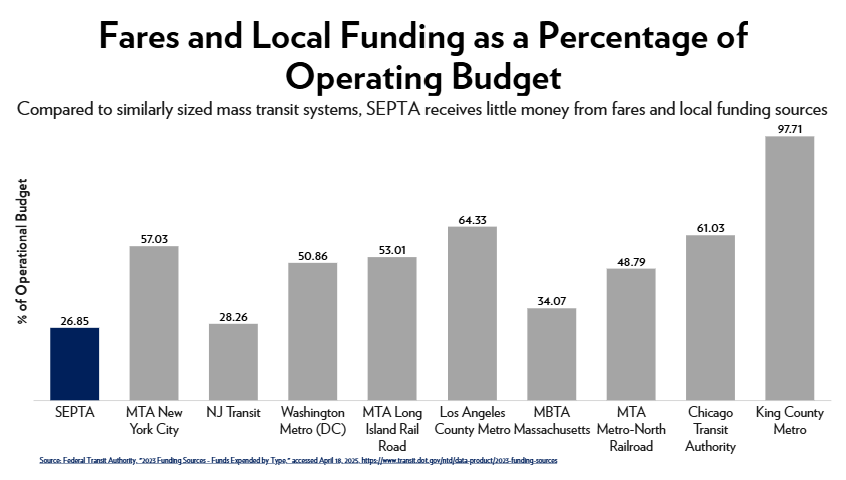
Most transit agencies nationwide rely on rider fare and local funding.
SEPTA is an entirely different story. State subsidies make up about two-thirds of its operating budget, while passenger fares cover about 16 percent. By comparison, Boston and New York draw 34 percent and 24 percent of their revenue from fares, respectively. Since 2007, SEPTA passenger revenue has fallen by about 20 percent, while state subsidies have grown by 169 percent.
Pennsylvania Already Invests Billions
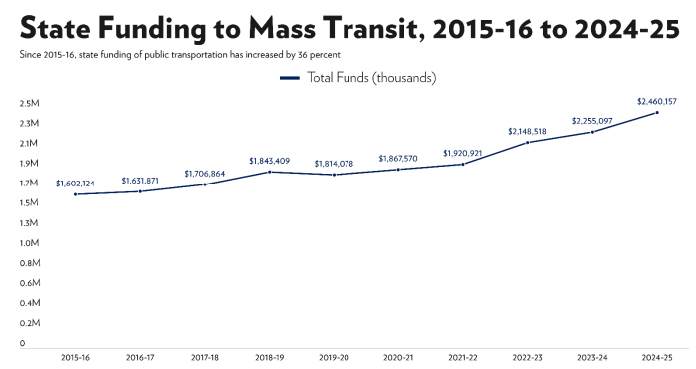
In fiscal year 2024–25, the state provided more than $2.4 billion to transit agencies, a 36 percent increase since 2015–16. Adding millions more without any added forms of transparency or accountability deserves scrutiny.
Ridership Remains Low Despite Record-Level Subsidies
Despite record-level subsidies, system-wide ridership remains at roughly 72 percent of pre-pandemic levels. Even SEPTA’s board members admit they don’t ride. Asking taxpayers to fund a larger system for a smaller pool of riders is a hard case to make.
SEPTA isn’t Cost-Effective
Cost per passenger mile is a fair yardstick for how efficiently agencies manage taxpayer dollars. According to federal data, SEPTA’s commuter rail costs $1.21 per passenger mile, compared with $0.83 in Denver and $0.94 in Boston. SEPTA buses cost $3.48, compared with $1.82 in Denver and $2.27 in New York.
Pennsylvanians Don’t Want to Bail It Out
While many may view public transit favorably, Pennsylvanians don’t want to bail out mismanaged transit agencies. Polling shows that 54 percent opposed bailing out mass transit, with only 35 percent supporting the proposal.
SEPTA Must Address Mismanagement
Time and again, news breaks about controversy or missteps by SEPTA. The latest examples include:
- In 2017, SEPTA ordered 45 cars from the China Railway Rolling Stock Corp. (CRRC), a company owned by the Chinese government. The order would cost the agency $185 million. Four years later, CRRC never delivered. Before canceling the contract, SEPTA had paid $50 million that it will never recoup.
- In 2019, SEPTA spent more than $24 million on 25 electric buses. But all the buses are broken, so SEPTA sidelined the EV fleet. One even burst into flames while collecting dust in a bus depot.
- Using taxpayer funds, SEPTA pays millions to lobbying firms.
- SEPTA announced a new $230 million electronic fare-collection system. This new system comes after already spending $285 million on a system that proved to be extremely glitchy.
- SEPTA continues to pay a six-figure salary for Leslie Richards, the agency’s former CEO, who left SEPTA last year.
This financial mismanagement has left SEPTA in the red. The agency faces a $200 million deficit next year, with no plan for enhanced accountability.
Considering its financial woes and mismanagement, SEPTA must first become a better steward of the funds it has before it demands more.
For more information, don’t miss out on our previous research and writing:
Connect With Us
Email Sign Up
"*" indicates required fields