Fact Sheet

U.S. Department of the Treasury Rules for Federal Scholarship Tax Credit
Rules governing the Federal Scholarship Tax Credit provide a pathway for Governor Shapiro to opt Pennsylvania in immediately.
What’s New
- On October 1, 2027, the IRS published rules governing the tax credit in preparation for the 2027 launch, clarifying:
- Individuals may donate up to $1,700 annually, but married couples filing jointly can donate up to $3,400 annually when each spouse donates separately.
- New guidelines allow states and scholarship organizations to register as scholarship-granting organizations (SGOs) in 2026, preparing to receive donations and award scholarships in 2027.
- Governors must follow federal guidelines and may not create additional participation rules.
- Scholarships for special-needs students, foster children, and students applying for tutoring receive priority.[1]
Background
- In July 2025, Congress passed the Federal Scholarship Tax Credit (FSTC) in Section 70411 of the budget reconciliation.[2]
- The FSTC provides scholarships for qualified educational expenses for K–12 public and private school students in participating states. Scholarships cover tuition, fees, books, uniforms, school supplies, tutoring, extended day programming, computer equipment, and special education expenses at no cost to the state or school districts.
- All taxpayers are eligible to donate and receive a tax credit, but only students in states that have opted in can receive scholarships. States that don’t opt in will see donation money flow to students in other states.
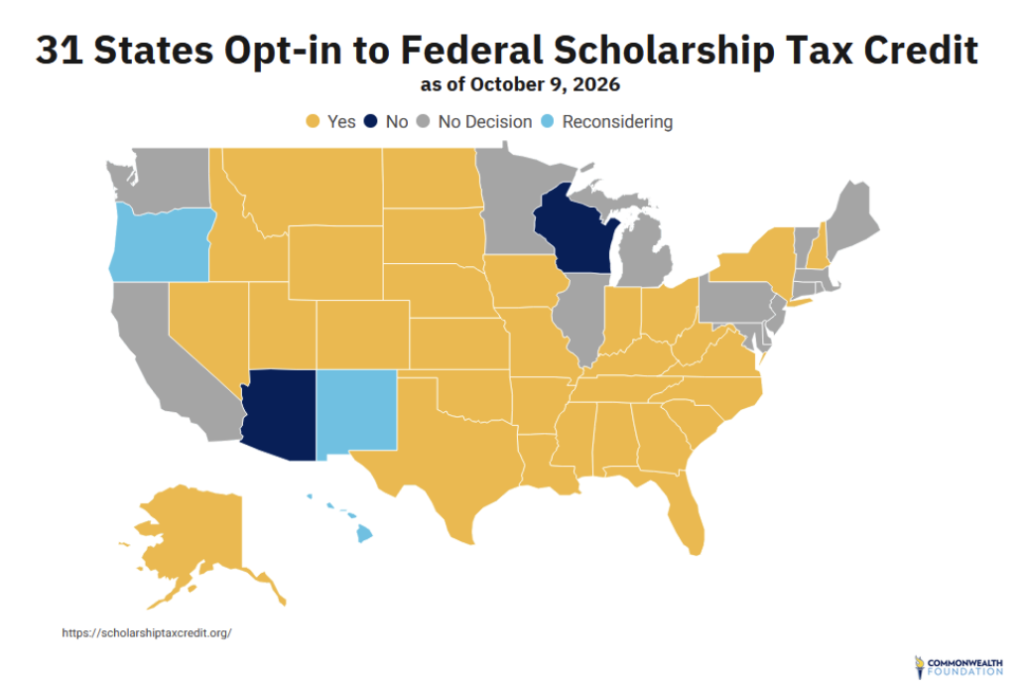
- To date, 30 states have submitted the advance election form to opt in. States must opt in by January 1, 2027, and provide a list of eligible SGOs in that state to participate in 2027.[3]
Pennsylvania’s Participation
- About 1.8 million K–12 Pennsylvania students, in both public and private schools, are eligible to participate.[4]
- If 10 percent of Pennsylvania’s eligible taxpayers donate in 2027, $700 million in federal tax dollars will flow to Pennsylvania students in the first year, or fund students in other states if Pennsylvania fails to opt in.[5]
Eligible Students
- Students will apply via one of Pennsylvania’s established scholarship organizations.[6]
- Maximum household income for Pennsylvania is $368,100 for a family of four.[7]
- Nearly 90 percent of Pennsylvania’s K–12 students qualify. Scholarships cover tuition, fees, books, uniforms, school supplies, tutoring, extended day programming, computer equipment, and special education expenses.[8]
- Students receiving Pennsylvania’s Educational Improvement Tax Credit (EITC),[9] Opportunity Scholarship Tax Credit (OSTC), and Economically Disadvantaged Schools (EDS) scholarships would qualify for the FSTC.[10]
Eligible Donors
- Individual donors receive a 100 percent, non-refundable IRS tax credit when donating up to $1,700 annually, or $3,400 for married couples filing jointly when both spouses donate separately.
- Donors may contribute to any SGO in the United States.
- Donors to Pennsylvania’s EITC, OSTC, and EDS may also donate to the FSTC program, but must make a separate donation to receive the federal tax credit.
- The tax credit only applies to individual income taxes, not corporate taxes. Unlike EITC, corporations cannot donate under the FSTC.
Eligible Scholarship-Granting Organizations
- The federal tax credit scholarship will utilize SGOs to allocate K–12 scholarships to students attending public, private, charter/cyber charter, career technical, and other schools.
- Scholarship awards are not capped by law or regulation but will be determined by the amount of donations raised, SGO policies, and student need.
- SGOs must:
- Register as an SGO with the state and the IRS.
- Be a nonprofit entity exempt from tax per sections 501(c)(3) and 501(a) of the Internal Revenue Code (IRC), “not a private foundation,” and must spend at least 90 percent of donations on scholarship awards.
- Pennsylvania’s EITC has a similar requirement for scholarship organizations. In practice, the 250 organizations average using 96 percent of their donations on scholarships.[11]
- For nonprofits whose primary function is providing scholarships, the 90-percent threshold applies to only funds raised through the FSTC (not all organizational revenue) and can be kept in a dedicated or restricted account.
- Award scholarships to at least ten students, fund scholarships for more than one school, and may not designate donations for a particular student.
- Annually conduct a third-party programmatic or financial audit.
Governor Shapiro: Opt In Now
The federal regulations provide Gov. Josh Shapiro with the information he needs to opt in.
- Nearly two million K–12 students attending public and private schools across Pennsylvania will benefit from this program.
- Failure to opt in will result in $700 million in donations leaving Pennsylvania in 2027 to fund students in states that have opted in.
[1] Internal Revenue Service, “Federal Scholarship Tax Credit,” Federal Register 91, no. 191 (October 2, 2026): 62655–72, https://www.federalregister.gov/documents/2026/10/02/2026-20264/federal-scholarship-tax-credit.
[2] U.S. Congress, House, One Big Beautiful Bill Act, HR 1, 119th Cong., 1st sess., engrossed in House May 22, 2025, https://www.congress.gov/bill/119th-congress/house-bill/1/text.
[3] Internal Revenue Service. Form 15714: Advance Election to Participate Under Section 25F for 2027. Rev. Dec. 2025. https://www.irs.gov/pub/irs-pdf/f15714.pdf.
[4] Pennsylvania Department of Education, “Enrollment,” Commonwealth of Pennsylvania, accessed October 5, 2026, https://www.pa.gov/agencies/education/data-and-reporting/enrollment.
[5] James Paul, “Education Freedom Tax Credit: What States Lose by Opting Out,” America First Policy Institute, March 30, 2026, https://americafirstpolicy.com/issues/education-freedom-tax-credit-what-states-lose-by-opting-out/.
[6] Pennsylvania Department of Community and Economic Development, “Scholarship Organizations,” Commonwealth of Pennsylvania, accessed October 5, 2026, https://dced.pa.gov/scholarship-organizations/.
[7] Drew Catt, “Updated Eligibility Income Limits for Scholarship Recipients for the New Federal Tax Credit for Scholarships,” EdChoice (blog), May 21, 2026, https://www.edchoice.org/2026-updated-eligibility-income-limits/.
[8] Patrick Graff, “Who Can Receive a Scholarship Under the Education Freedom Tax Credit? New Report Details Estimates for Every State,” AFC Scholarship Fund, July 2026, https://afcscholarshipfund.org/articles/who-can-receive-eftc-scholarship-eligible-k12-population-report/.
[9] Rachel Langan, “Pennsylvania’s Education Tax Credit Scholarships: How EITC Serves Children and Families in the Commonwealth,” 2nd ed., Commonwealth Foundation, May 13, 2026, https://commonwealthfoundation.org/research/how-eitc-serves-children-and-families-in-the-commonwealth-2nd-edition/.
[10] Rachel Langan, “EITC and Economically Disadvantaged Schools,” Commonwealth Foundation, April 30, 2025, https://commonwealthfoundation.org/research/eitc-economically-disadvantaged-schools-pa/.
[11] Rachel Langan, “Pennsylvania’s Education Tax Credit Scholarships: How EITC Serves Children and Families in the Commonwealth,” 2nd ed., Commonwealth Foundation, May 13, 2026, https://commonwealthfoundation.org/research/how-eitc-serves-children-and-families-in-the-commonwealth-2nd-edition/.