Testimony

Expanding Educational Opportunities for Every Child
Testimony of Kevin Kane, Director of Legislative Strategy and Government Affairs
Commonwealth Foundation
House Republican Policy Committee
“Expanding Educational Opportunities for Every Child”
October 22, 2026
Chairman Rowe and members of the committee:
Thank you for the invitation to testify. My name is Kevin Kane, and I serve as the Senior Director of Legislative Strategy and Government Affairs for the Commonwealth Foundation, a state-based think tank that advances free-market policy solutions to empower all Pennsylvanians to thrive.
I appreciate the committee’s attention to Pennsylvania’s successful educational tax-credit programs and the Federal Scholarship Tax Credit.
Introduction
Congress created the Federal Scholarship Tax Credit (FSTC) in 2025, and the program is scheduled to begin in 2027.
All taxpayers are eligible to donate and receive a tax credit through the FSTC, but Pennsylvania students can benefit only if the state opts in. The deadline is January 1, 2027.
This is a practical opportunity for Pennsylvania. Our state has operated scholarship tax credits for 25 years. The FSTC builds on that experience and offers a new source of support for students in private and public schools, charter schools, career and technical programs, and other learning settings.
Key Facts about the FSTC
Beginning in 2027, individual taxpayers with federal income tax liability may donate to eligible scholarship-granting organizations (SGOs) and receive a 100 percent federal tax credit. An individual may donate up to $1,700 per year and receive a federal tax credit equal to the donation. Married couples filing jointly may claim up to $3,400 when each spouse makes a donation. The credit is nonrefundable, so it cannot exceed the donor’s federal income tax liability.
Using these donations, SGOs can provide students—in public or private school—with scholarships for tuition, fees, tutoring, special needs services, after-school programs, books, or supplies, at no cost to the state or school districts.
Participating does not require state spending, reduce funding for public schools, or cost school districts a dime. The money comes from private donors receiving a federal tax credit.
However, states must opt in by January 1 and provide a list of approved SGOs for students to benefit. Donors may contribute to any SGO in the United States.
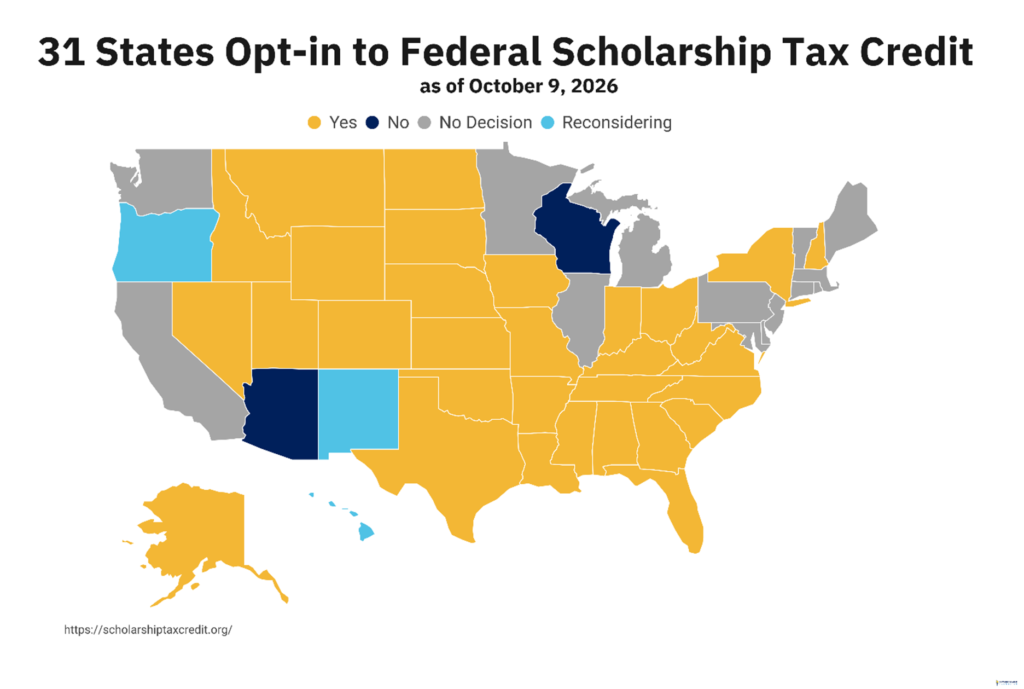
That is, even taxpayers in opted-out states may donate to SGOs in another state. If Pennsylvania doesn’t opt in—and as of this writing, Gov. Josh Shapiro has taken no action—donor funds would flow out of the commonwealth.
Already 31 states, including those with Democratic governors, have opted in. Most recently, Gov. Kathy Hochul announced that New York, our neighbor to the north, would be participating.
What Pennsylvania’s Experience Shows
Pennsylvania has a 25-year history of tax-credit scholarships, beginning with the Educational Improvement Tax Credit (EITC) and later the Opportunity Scholarship Tax Credit (OSTC). These two tax credits provide a tested model for donor-funded scholarships.
Like the federal tax credit, the EITC and OSTC provide donors with a state tax credit when contributing to scholarship organizations (SOs in state nomenclature), along with pre-K scholarship organizations, and Educational Improvement Organizations (EIOs) that work in public schools or with public school students.
Unlike the FSTC, the state tax credit is not dollar-for-dollar (up to a 90-percent credit), and state law caps the total amount of credits. EITC and OSTC are also corporate tax credits (unlike FSTC), though individuals can participate through joining a special-purpose entity LLC.
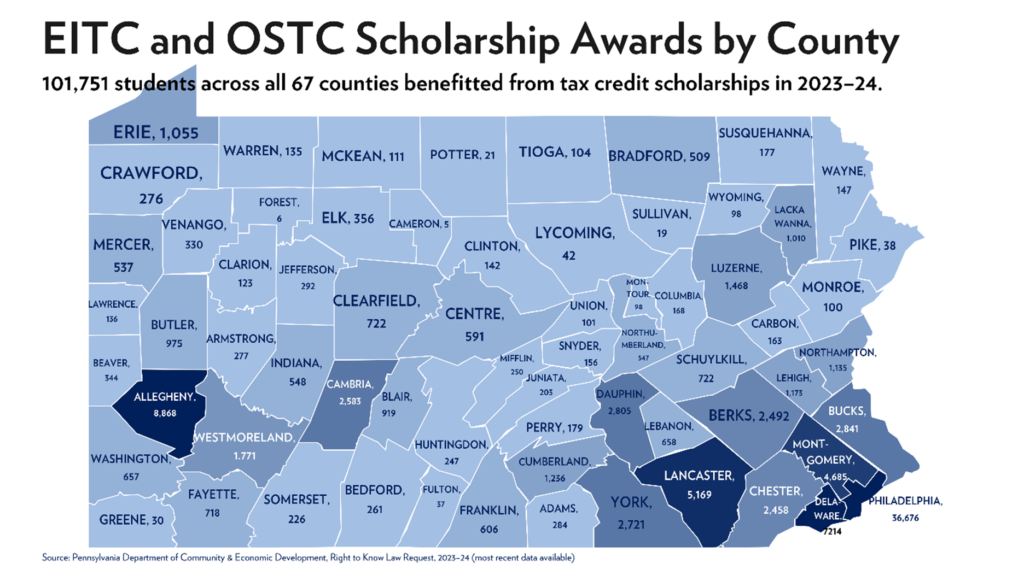
In 2023–24, EITC and OSTC scholarship organizations provided more than 101,000 scholarships to K–12 students, an increase of 16,181 from the prior year. Since EITC began in 2001, the programs have awarded more than one million scholarships.
Scholarship organizations awarded EITC scholarships to students in all 67 Pennsylvania counties.
The programs reach low- and middle-income families.
Commonwealth Foundation has conducted two studies of the EITC and OSTC tax credits. In the latest report, using data from service providers that support schools and scholarship organizations, we found that average household income for EITC and OSTC scholarship recipients across the state ranges between $44,000 and $78,100 annually.
This compares to Pennsylvania’s median family income of more than $100,000 and is less than half the income limit for a family of four allowed under state law.
In terms of a regional analysis, most families receiving tax-credit scholarships earn below the median income level for their respective counties. Additionally, we found that the median tuition among participating private schools was less than $10,000.
Thus, while the average scholarship award in 2023-24 was $2,600, it made a significant dent in the end cost for families who otherwise could not afford educational options.
For example, Independence Mission Schools (IMS) is an independent nonprofit network of 14 Catholic schools in Philadelphia, offering pre-K through eighth-grade education to students from families of all faiths, including many low-income families. A majority of IMS’s 3,500 students rely on EITC scholarships. The median family income of their students is $44,358, and approximately one-third of their students come from families in poverty.
Children’s Scholarship Fund Philadelphia (CSFP) provides another outstanding example. Its 2026 report found that CSFP families had a median household income of $42,837, and nearly two-thirds of students qualified for free or reduced-price lunch. The report also found that CSFP students outperformed School District of Philadelphia students in academic achievement.
Unfortunately, the demand for scholarships outpaces the supply, which is why Pennsylvania’s participation in the FSTC is crucial. In 2023-24, scholarship organizations had to turn away 68,817 applications because available tax credits were capped. Nearly 40 percent of applications went unfunded.
Benefits of FSTC for Pennsylvania
Pennsylvania has a clear need for additional scholarship support. The federal tax credit offers a way to expand support beyond those state tax credit limits.
Pennsylvania already has 250 scholarship organizations in place that are ready and eager to participate. These include groups like Children’s Scholarship Fund Philadelphia, BLOCS, and the Orthodox Union.
The FSTC can complement existing scholarships. Students who receive EITC, OSTC, or Economically Disadvantaged Schools scholarships would also qualify for FSTC scholarships. That means the FSTC could help families cover more of their child’s educational expenses and help students who already receive partial assistance.
Additionally, the FSTC is not limited to tuition for private schools. Public school students would also be eligible for scholarships for educational services.
These could include tutoring, books, school supplies, computer equipment, extended-day programming, and special education expenses. The federal tax credit could support a student who wants to remain in public school but needs additional academic help, specialized equipment, or services beyond what the school can provide.
Students in households with incomes up to 300 percent of the median gross income level by county, as determined by the U.S. Department of Housing and Urban Development (HUD), are eligible to participate.
Around 90 percent of Pennsylvania’s K–12 students qualify for the scholarship based on income. That’s about 1.8 million students eligible statewide.
For low-income areas, the eligibility percentage would be even higher. For example, we estimate that more than 95 percent of students in the Allentown School District would be eligible for FSTC scholarships.
The recent Treasury rules clarified that individuals may donate up to $1,700 and married couples up to $3,400 (with each making a separate donation) and receive a credit under FSTC.
The potential benefit is substantial. If 10 percent of eligible Pennsylvania taxpayers donate at that level, that would yield around $700 million in donations to help Pennsylvania students.
That is a projection, not a guaranteed amount; the actual total will depend on donor participation and scholarship applications. But it gives a sense of the resources Pennsylvania could make available to students without drawing from the state budget.
Locally, this represents about $12.3 million in potential donations in Lehigh and Northampton Counties alone. At least five school districts in those counties—Allentown, Bethlehem, Easton, Parkland and East Penn—could lose out on more than $1 million in potential donations.
If Pennsylvania does not opt in, residents may still donate to SGOs in states that participate. In that case, eligible students in those states could benefit while Pennsylvania students could not. Opting in gives Pennsylvania families and organizations a chance to keep these resources working here.
Eligible Scholarship Organizations
The Treasury Department’s recently released proposed regulations provide clarity on the process for scholarship orgs to sign up and take donors. The temporary rules are in effect now, specifying how both states and SGOs can act to participate in 2027.
The FSTC will utilize SGOs to allocate K–12 scholarships to students attending private or public schools—including students enrolled in district schools, charter schools, cyber charter schools, or career and technical schools.
SGOs must be nonprofit organizations, register as an SGO with the state and the IRS, award scholarships to at least 10 students attending more than one school, avoid donor designation of funds for a particular student, and conduct an annual third-party audit (or programmatic financial review for smaller nonprofits).
At least 90 percent of FSTC donations must be used for scholarships. Organizations that are primarily scholarship-making entities (85 percent of overall revenue going towards scholarships, from all donations sources), can create a segregated fund for FSTC-eligible donations, rather than form a new organization, to comply with the 90 percent rule.
Most of Pennsylvania’s 250 established scholarship organizations are well positioned to take part (as are many of the 120 EIOs). Pennsylvania law already mandates a similar percentage of tax credit donations be used for scholarships—and records show that even before that threshold was increased, scholarship organizations were, on average, giving 96 percent of donations to scholarships under the EITC and OSTC.
Each SGO will determine the scholarship amount to award qualifying students (the $1,700/$3,400 cap applies to tax-credit eligible donation, not the scholarship value). SGOs will have the flexibility to direct funds to the kids who need it most. Some SGOs will provide full tuition scholarships; others will provide partial scholarships. As Pennsylvania’s experience shows, scholarship organizations may focus on low-income students, students with special needs, or students from a particular geographic region.
Governors must opt in for students in their state to qualify, and Treasury’s rules do not allow governors to add state participation requirements. This important provision allows the religious liberty of schools to remain intact.
The FSTC is separate from Pennsylvania’s EITC and OSTC. A donor who already gives to those programs may also donate through the federal tax credit but would need to make a separate donation to receive the federal credit.
However, for students and schools, FSTC scholarships will work alongside (or “stack” with) other scholarship awards, including private scholarships, as well as with Pennsylvania’s existing tax-credit scholarships.
Public-School Students and Programs That Would Benefit
As mentioned previously, the FSTC allows for scholarships that benefit public school students.
Moreover, public schools can use this fundraising opportunity to supplement school district programming by providing scholarships to income-qualified students. Parents will apply for a scholarship through a scholarship-granting organization (SGO) to receive scholarships based on family income.
Potential uses for public school students include:
- Tutoring or targeted academic help.
- Special-education services and related equipment.
- Books, school supplies, or computer equipment.
- Extended-day programming.
- Other qualified expenses that supplement services available through a student’s school.
This kind of individualized support can matter to students whose needs are not fully met by a single standard program. The FSTC would give families another potential source of help, while allowing them to pursue support appropriate for their child.
Pennsylvania currently has 120 educational improvement organizations (EIOs) participating in the EITC and supporting programs that benefit public-school students. These organizations include school district-affiliated nonprofits; mentoring, recreation, and after-school programs; arts and music groups; zoos and libraries; symphonies and dance organizations; and organizations serving students with special needs.
While these EIOs typically raise tax-credit donations for operating funds rather than scholarships, many are looking at how to take advantage of the FSTC to support their programming.
Andrew’s Gift is an EIO that shows why individualized support matters. After Andy Ward and his wife were told their son, Andrew, diagnosed with autism, would never read, write, speak, or type, they pioneered autism therapies for children, working with researchers in California to determine best practices and then worked to find doctors, therapists, nutritionists, and educators in Pennsylvania who could help their son, who is now 38 and lives a full life beyond expectations. Andy and his wife are committed to helping other kids with autism live a full life and founded Andrew’s Gift to provide resources to families living with autism.
This important program currently serves public school students 17 autism-support classrooms, by providing learning resources (iPads, sensory-regulation items, smartboards, training, plus staffing classrooms with speech and occupational therapists.) The FSTC could help families like Andrew’s pay for critical services that their public school district is unable to provide.
Pennsylvanians Support Educational Choice
Funding for Pennsylvania public schools increased 68 percent since 2015, to around $24,000 per student in the 2024–25 school year. Yet student outcomes have not improved. The Pennsylvania System of School Assessment (PSSA) 2025 results reveal that 51.5 percent of kids read below grade level, and in math, 58.3 percent score below basic or basic.
Thus, it is no surprise that parents are demanding additional educational options. Polling shows broad public support for Pennsylvania’s participation and for expanding educational options.
In our most recent poll finding, 61 percent of respondents graded Pennsylvania’s K–12 public school system a C or lower. Moreover, 89 percent supported expanding the state’s scholarship tax credits.
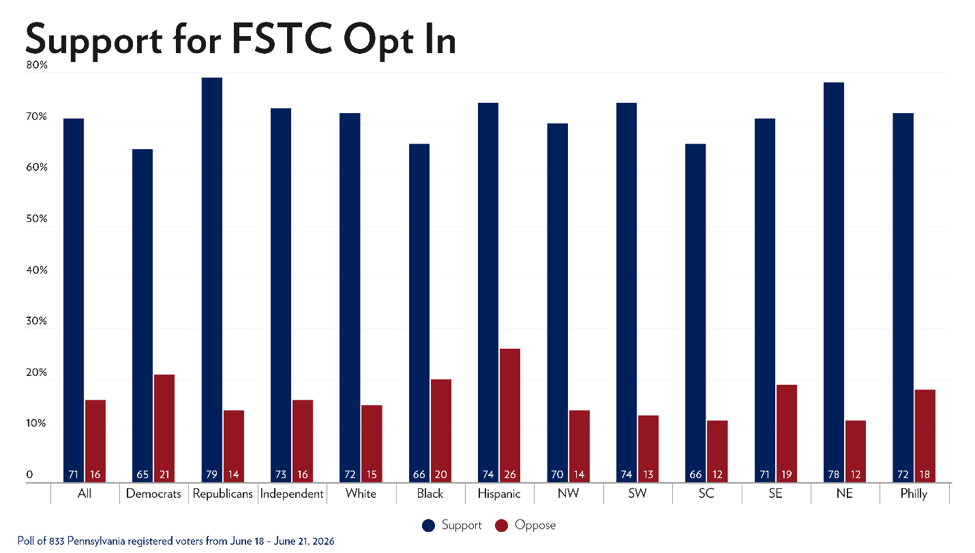
Commonwealth Foundation-commissioned polling, released in June 2026, asked specifically about the federal scholarship tax credit. This polling found that 71 percent of voters supported Gov. Shapiro opting into the FSTC, with strong support across all demographic groups.
Additionally, national surveys of parents from the National Parents Union found not only support for opting in, but desire to use it—an astounding 84 percent of parents said they would apply for scholarships if their children were eligible.
Conclusion
Pennsylvania’s EITC and OSTC show that scholarship organizations can reach families in every county. They also show that demand exceeds available funding: tens of thousands of applications go unfunded each year.
The federal tax credit offers another way to help students and families meet educational needs.
Pennsylvania has a near-term decision to make. The FSTC could bring new federal tax credit donations to Pennsylvania students without costing the state or public schools. It could help 1.8 million Pennsylvania students access additional educational options. In could unleash $700 million in additional funding for our students’ education.
But should Pennsylvania choose not to participate, donations will flow to our neighboring states, and commonwealth students will be denied educational opportunity.